Private equity deal flow best practices


In 2026, private equity is being judged on realized returns. Global un-exited PE portfolio value stands at $3.8 trillion, according to Bain & Company's Global Private Equity Report 2026, and limited partners (LPs) want distributions. That puts pressure on every stage of the deal cycle, starting with deal flow.
Affinity's 2026 Private Equity Benchmark Report, built on platform data from more than 300 PE firms, shows where strong and weak deal flow actually differ. Firms communicate at nearly the same rate: the busiest firms' users handle barely twice the email of the quietest. But the top quarter of firms turns more than 61% of their tracked relationships into introductions, while the bottom quarter activates under 15%. Better PE deal flow comes less from doing more outreach and more from putting the network you already have to work.
This article covers what deal flow is, how it moves through the private equity deal process, four best practices for improving it, and the benchmarks you can use to see where your firm stands.
Key takeaways
- Successful PE deal sourcing relies heavily on relationship building and network maintenance, with the most valuable opportunities typically coming from warm connections rather than cold outreach.
- PE firms look alike on effort and nothing alike on output. Email volume varies about 2x across firms, while introductions and network activation vary about 4x.
- The typical PE firm turns 33.9% of its tracked relationships into introductions, and the top quarter clears 61%. For most firms, the fastest gain is activating the network they already have.
- One person holds a median 31% of a PE firm's strong relationships, and the top three hold 72%. That concentration is both a sourcing bottleneck and a continuity risk.
What is private equity deal flow?
Private equity deal flow is the quantity and quality of investment opportunities a firm sees, and the process by which it sources, evaluates, and wins them. Good deal flow is a key indicator of a successful fund: a steady supply of opportunities that fit the investment thesis, with enough of them reached early, before a competitive auction sets the price.
Deal flow reaches a PE firm through two broad channels:
- Intermediated deal flow arrives through investment banks, M&A advisors, and business brokers running a sale process. It's reliable volume, but every other bidder on the banker's list sees the same deal.
- Proprietary deal flow comes from the firm's own relationships and outreach: direct conversations with founders and owners, referrals from portfolio company executives and lenders, and advisors who bring a deal early because they trust the team.
Most firms need both. The difference between busy deal flow and good deal flow is how much of it reaches the firm early, through a warm relationship.
Successful firms manage a large number of deals over long periods of time, which requires dedicated time for relationship building and connecting with their networks. When deal origination efforts stall, it can have long-term ramifications.
How does the private equity deal process work?
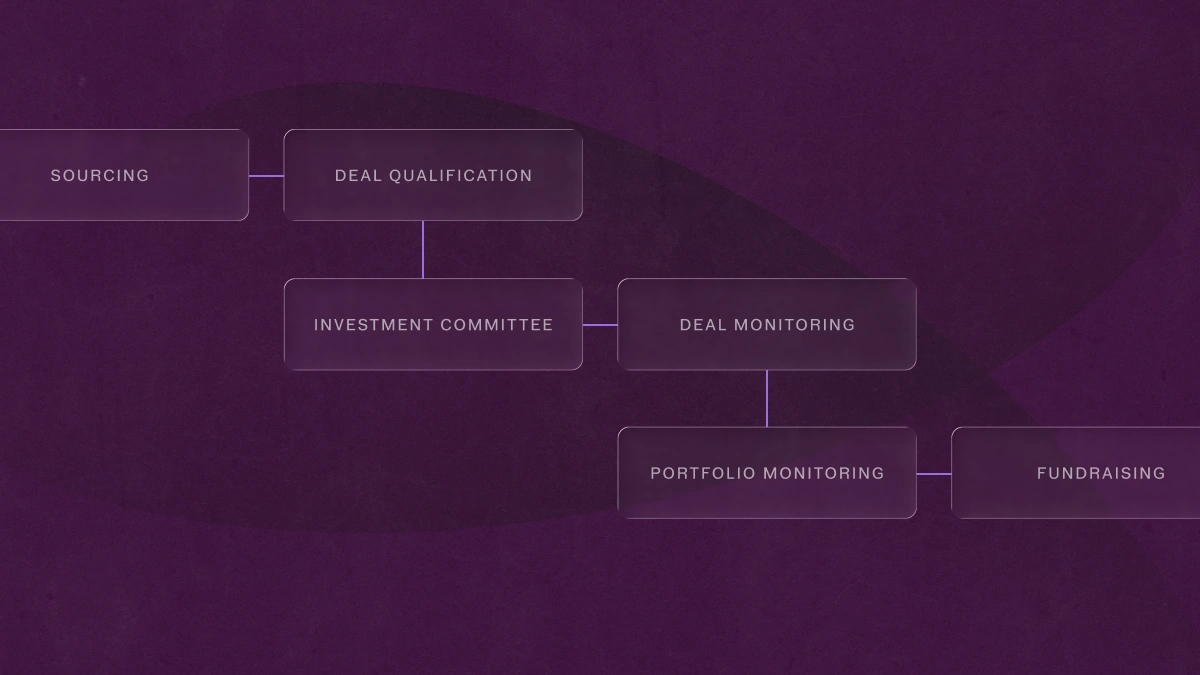
The private equity deal process moves an opportunity from first contact to close in a series of stages, and deal flow is the top of that funnel. A typical sequence looks like this:
- Sourcing and origination. The firm identifies targets through its network, intermediaries, and thesis-driven research.
- Screening. The team checks fit against the investment thesis (sector, size, geography, ownership, and situation) and reviews the teaser or confidential information memorandum (CIM).
- Indication of interest and management meetings. The firm submits a non-binding indication of interest (IOI) and meets the management team.
- Letter of intent. A letter of intent (LOI) sets price, structure, and usually a period of exclusivity.
- Due diligence. Financial, commercial, legal, and operational work tests the investment case. See our guide to private equity due diligence.
- Investment committee and close. The investment committee approves the deal, then definitive agreements and financing are finalized.
- Ownership and exit. The firm works on value creation, then exits. The relationships built along the way (portfolio executives, lenders, buyers) feed the next cycle of deal flow.
Deal flow determines what enters stage one. Every later stage decides how much of it becomes an investment, which is why the best firms manage sourcing and pipeline in the same system. For a stage-by-stage look, see how PE firms use CRM at every stage of the deal lifecycle.
Building a relationship-driven deal flow pipeline
A lot of attention in private equity goes to deal sourcing. Leading firms, however, know that better deal sourcing is a result of better relationships. People do business with people they know, like, and trust.
Most high-quality deals will come from warm connections in your network, not from cold outreach. If your network is strong, and your relationships are active and well maintained, you'll reach opportunities before competing firms do. Some firms take this further by structuring initial minority investments that create a built-in pipeline for follow-on deals.
The benchmark data shows how much room most firms have here. The typical PE firm turns about a third of its tracked relationships (33.9%) into introductions. The relationships already exist; the top quarter simply surfaces and uses them as a habit. When a larger fund can outbid you on price, a warm path to the owner is often the counterweight.
Successful dealmakers heavily weight their time toward relationship-building and deepening their connections. They stay top of mind and grow their sphere of influence by making the effort to reach out, connect, and provide value to the people in their networks.
For M&A-specific sourcing strategies, explore our guide to M&A deal sourcing and origination best practices.
Network like an industry leader
Networking is the best way to increase PE deal flow when it's done well. Leading private equity partners, principals, and VPs take a long-term view of relationship management. They make an effort to give as much as they get and generously connect people in their networks, share insights, and look for ways to help others.
{{read-the-report-1="/rt-components"}}
Private equity deal flow best practices
Here are four ways to improve PE deal flow, each tied to a benchmark you can check against your own firm.
Align on your investment thesis and strategy
The first step to increasing quality deal flow is to keep your team aligned with your investment strategy.
What is your fund's investment thesis? What kind of deals is your firm looking to invest in? Consider parameters like company size, geography, vertical, ownership type, or cash flow profile. Also consider the expertise your firm and LPs bring to the table, and what kinds of companies you could help most effectively in value creation. Understanding how LPs and GPs collaborate on investment strategy can help ensure alignment from the outset.
What constraints are you working within? Is your firm staying away from certain segments or sectors?
Then turn the thesis into screening criteria everyone applies the same way, so a new referral can be qualified quickly instead of debated in the pipeline meeting. Armira, a European private equity firm, tracks a target universe of roughly 20,000 companies in a single pipeline the whole firm can see.
"The team no longer starts from gut feel. It starts from a ranked list." — Niklas Krusche, Head of Origination & AI, Armira
Assess your existing network for untapped opportunities
Growing your network is important, but you likely have strong opportunities in the network you already have. The benchmark data backs this up: the typical PE user adds 36 new contacts a month, yet the typical firm activates only a third of the relationships it tracks. A high add-rate with low activation means the network is growing faster than it's working.
To read your own number, divide the relationships your team has made introductions into by the total relationships you track. Under 15% is bottom-quartile, 33.9% is typical, and above 61% puts you among the most active networks in PE.
Revisit past referrals and passed opportunities
Perhaps an opportunity you passed on a year ago would be perfect for your firm today. To keep these records current, leading PE firms are turning to CRM platforms that capture activity as it happens and surface it quickly later on.
Evaluate your network for new referrals
What existing relationships do you have that might give you inroads to new opportunities? Consider:
- Service providers, including lawyers, insurance brokers, accountants, and consultants
- Other investors at private equity funds, venture capital firms, and investment banks
- Domain experts
- Transaction intermediaries, including M&A advisors, investment bankers, and business brokers
When these relationships are centralized in a single source of truth, you can more easily understand who knows who. If you're using a CRM with relationship intelligence, you can also quantify these connections with relationship scoring that goes beyond who knows who and takes into account how well they know each other.
Nurture your most important relationships
Healthy professional relationships go deeper than surface level. It can be tempting to speed up relationship maintenance and jump straight to deal-related questions, but that does little to build real connection.
- Actively connect people in and across your network with other people they would find value in knowing.
- Send them content that might interest them, including news clips and new research.
- Share their content across your network and marketing channels, and let them know how their content is helping you personally.
- Check in on a personal level. Ask about their family or a hobby. Reach out when you see a big weather event hitting their area.
- If you're attending an event in their area, see if they can meet for dinner. Or better yet, offer them a ticket to the event if it's appropriate.
Most importantly, make relationship building and maintenance a priority on your weekly schedule. Set time aside to meaningfully connect with people in your network every week, and use tools with built-in reminders so you never let a contact slip away.
Introductions are the clearest output of this work. The typical PE user makes 18 introductions a month; the top quarter makes more than 33, and the bottom quarter fewer than eight. That median rose from 11.9 to 18.0 between January 2024 and Q2 2026, so the bar is moving.
Spread key relationships beyond a few partners
Every firm has partners whose networks run deeper than everyone else's. The benchmark puts a number on it: one person sits at the center of a median 31% of a PE firm's strong relationships, and the top three hold 72% between them. Even the least concentrated quarter of firms has one person holding about a fifth of all strong ties.
That concentration limits deal flow in two ways. Opportunities that run through one partner's inbox only move as fast as that partner does, and if that partner retires or leaves, much of the firm's sourcing reach can leave too.
To reduce the risk, first measure it: what share of your strongest relationships sits with your single most-connected person, and with your top three? Above 44% in one person is among the most concentrated in PE; below 20% is among the most distributed. Then bring more of the team into key relationships. The 2025 edition of the benchmark report found that high-performing firms keep engagement multi-threaded across counterparties, from deal teams to the C-suite, rather than routing everything through one contact.
How do you measure private equity deal flow?
Measure deal flow at two levels: the pipeline itself, and the relationship work underneath it.
Pipeline metrics show what's entering and advancing:
- Volume by source. How many new opportunities arrive each month, split between proprietary and intermediated channels.
- Stage conversion. What share of deals moves from screening to IOI, LOI, and close, and where deals stall.
- Time from first touch to deal added. Top firms compress this interval, surfacing opportunities before a process becomes competitive.
- Pass reasons. Why deals are declined, so the thesis and screening criteria stay sharp.
A clean pipeline also makes the weekly pipeline meeting shorter and more useful.
"Affinity saves us a couple of hours a week in the preparation and execution of our pipeline meeting, and with how expensive good people are in our industry, a couple hours a week is worth a lot of money." — Bryan Kim, Partner, Invus Opportunities
Relationship benchmarks show whether the network feeding that pipeline is working. These are per-firm medians and quartiles from Affinity's 2026 Private Equity Benchmark Report:
| Benchmark | Bottom quarter | Median | Top quarter |
|---|---|---|---|
| Emails sent and received per user, per month | Below 692 | 1,087 | Not published |
| New contacts added per user, per month | Not published | 36 | More than 66 |
| Introductions per user, per month | Fewer than 8 | 18 | More than 33 |
| Network activation (relationships introduced into ÷ relationships tracked) | Under 15% | 33.9% | More than 61% |
| Share of strong relationships held by the most-connected person | Below 20%, most distributed | 31% | Above 44%, most concentrated |
The pattern across the table is what's useful. Activity metrics like email cluster tightly, so most firms will read as "normal" there. Introductions and activation spread about 4x, which is where firms actually differ and where the headroom is.
{{request-demo-short="/rt-components"}}
How are leading PE firms updating the way they manage their deal flow?
Some PE firms are sticking with traditional dealmaking processes, while others are adopting new processes and technologies to keep up with a more selective market.
Here are two things these firms are doing differently.
Automating data capture
You can only measure and act on relationship activity that's recorded. That's why leading firms are moving to automated data capture, which also means less time on manual data entry and more time building the relationships that improve deal flow.
Private equity firms manage a lot of data:
- Contact information
- Meetings and meeting notes
- Phone calls
- Emails
- Company moves
- Role changes
- Industry notes
Automating data entry frees your team from logging this by hand, and that time can be redirected to networking, connecting, and building relationships.
Affinity automates data capture by populating CRM fields from emails, calendar events, and external data partners like PitchBook and Crunchbase. Affinity Ascend's Data Update agent goes a step further, suggesting CRM field updates from meeting notes so your team can review and apply them instead of typing them in.
Because Affinity captures contact information and activity as it happens, your team doesn't have to take time away from its network to keep the CRM up to date.
Creating a single source of truth
If everyone on your deal team uses a different system to record contact and deal information, there will be gaps in information and communication, and your firm will lose out on potential investments because of it.
Affinity consolidates deal and relationship data in one centralized system. Your deal flow lives across your team's opportunities, communications, and contact data; put it in one place, and your firm can move with speed and confidence. Seaside Equity Partners has closed 15+ deals since implementing Affinity.
"It's night and day. We are way more organized when it comes to relationships—everyone is on the same page. We've won a good amount of deals that we wouldn't have won if we hadn't changed over to Affinity." — Doug Parker, Head of Origination, Seaside Equity Partners
Frequently asked questions
What is private equity deal flow?
Private equity deal flow is the quantity and quality of investment opportunities a PE firm sees, and the process it uses to source, evaluate, and win them. It comes from intermediated channels, such as investment banks running sale processes, and proprietary channels, such as the firm's own relationships with owners, executives, and advisors.
How do PE firms improve deal flow?
PE firms improve deal flow by aligning the team on a clear investment thesis, activating relationships they already have, nurturing key relationships consistently, and spreading those relationships across more of the team. Affinity's 2026 benchmark data shows the biggest gap between firms is network activation, not activity: the top quarter turns more than 61% of tracked relationships into introductions, versus 33.9% for the typical firm.
What is proprietary deal flow?
Proprietary deal flow is an investment opportunity a firm reaches through its own relationships or outreach rather than through a banker-run auction. Because fewer bidders see it, a proprietary deal can offer better pricing and more time to build conviction.
How do you track private equity deal flow?
Track deal flow in a CRM that records every opportunity with its source and stage, and captures emails and meetings automatically. Then review volume by source, stage conversion, time from first touch to deal added, and relationship benchmarks such as introductions per user and network activation.
How many introductions does a typical PE deal team make?
The typical private equity user makes 18 introductions a month, according to Affinity's 2026 Private Equity Benchmark Report. Top-quarter firms' users make more than 33, and bottom-quarter firms' users make fewer than eight. Introductions are counted per recipient pair, so one email introducing three people counts as two.
What's next for your private equity deal flow?
Increasing your deal flow and keeping your pipeline full of high-quality opportunities depends more than anything on how well your network works. Make sure your systems and processes support relationship-building above all else, and that includes your CRM.
In addition to automating data capture and creating a single source of truth, Affinity gives you visibility into your historical and active deal pipeline, so you can see the full picture of every deal and every relationship. If you're weighing Affinity against a general-purpose CRM, see how it compares to Salesforce and Pipedrive.
To see how your firm compares on every benchmark in this article, read the full 2026 Private Equity Benchmark Report, or talk to an Affinity team member about putting more of your network to work.
About the data: benchmarks in this article come from Affinity's 2026 Private Equity Benchmark Report, which analyzes aggregated, anonymized platform activity from more than 300 private equity firms from January 2024 through Q2 2026. Figures are per-firm medians reported as monthly rates, with quartile ranges. Key-person concentration is derived from Affinity's relationship-strength model. Firms that opted out of research use of their data are excluded.
Related Articles


Put your firm’s network to work