DEAL MANAGEMENT
Win deals faster
Transform how you evaluate and close opportunities with purpose-built automations and AI-driven insights









.webp)
Manage your deals to close faster
Manual deal tracking and scattered information slow down investment decisions. Centralize your pipeline with automated activity capture and real-time status updates.
All your deal data together in one place
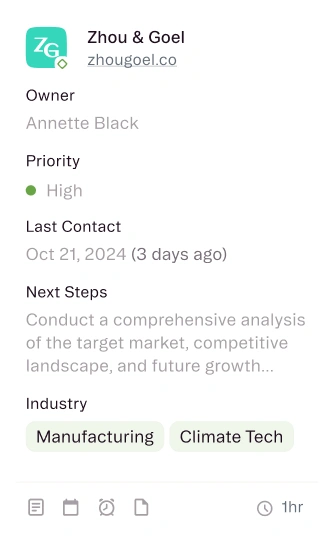
Automatically keep all deal information, interactions, and documents organized in one place for all your team to access.
Automate pipeline tracking
Monitor deal progress with automated status updates, custom priority fields, and clear visibility into next steps.
Access deals anywhere
Manage your pipeline and access deal insights directly from your inbox, browser, and the Affinity mobile app.


Keep everyone aligned on deals
Coordinating deal stages across teams often leads to missed deadlines and delayed decisions. Standardize your approach with automated workflows.
Structure your pipeline stages
Create consistent deal qualification and progression criteria across investment teams.
Streamline due diligence
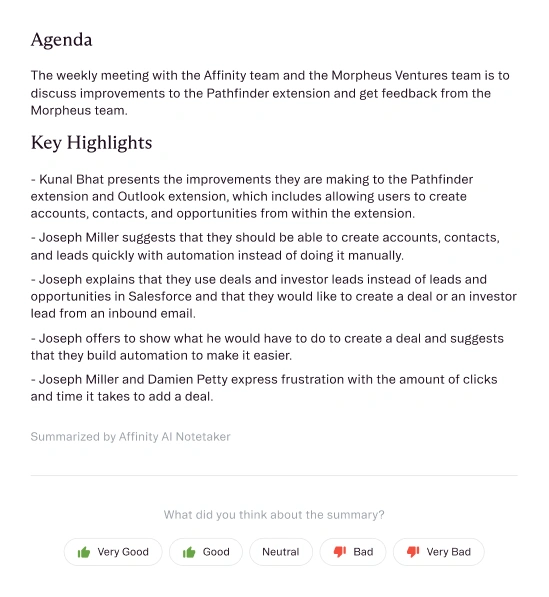
Capture meeting insights with AI-powered notes and organize reference calls in one searchable platform.
Manage team meetings effectively
Run efficient Monday morning meetings with Kanban board views showcasing real-time pipeline insights and action items.
Make your deal processes better
Improving deal execution requires understanding what works. Monitor team performance and deal patterns to refine your approach and increase win rates.
Track team and deal performance
Monitor key pipeline metrics and team activity with customizable dashboards to understand deal progression and identify the practices that close deals faster.
Share deal insights securely
Keep external stakeholders aligned using Collaborator Seats to share relevant deal information and updates.
Maintain momentum to close
Automate follow-ups, set reminders, and use AI-driven insights to keep deals moving forward efficiently.

Where to next?

Best practices guide for deal management
Maximize the value Affinity can bring to your deal management workflow.

Why it's time to automate CRM data entry
Learn what automated data entry processes can do for your firm and how to implement them.

Samsung Next case study
See how Samsung Next centralizes deal flow and shares details across teams with Affinity.
Frequently Asked Questions
Deal management is the practice of moving an opportunity from first contact through investment committee and close, with a shared record of where it stands and who is responsible. In private capital it spans years rather than weeks, involves a rotating cast of internal and external parties, and has to survive the departure of whoever originated it.
Most firms run five to seven stages: sourced, screened, in diligence, at investment committee, and closed or passed, with a separate track for companies being monitored instead of actively worked. However, the count matters less than the discipline. Stages that are too granular stop getting updated, and a pipeline nobody updates stops informing decisions.
A pass is data. Companies return to market, theses change, and a business that was too early two years ago may be exactly right now. Firms that keep the pass reason and the diligence attached to the record can revisit a decision years later with the original reasoning intact. The alternative is starting the work over from a blank page.
By separating the two kinds of data. Activity, meaning who spoke to whom and when, can be captured automatically from email and calendar. Judgment, such as stage and pass reason, still needs a human. Automating the first means the only thing anyone types is the thing only they can know.
Two things: data entry they aren't compensated for, and a pipeline view that doesn't match how they think about the deal. Tools built for sales pipelines fail on both counts. Adoption holds when activity capture is automatic and the record structure matches the firm's actual process, which is why BDev Ventures and FOW Partners reached full adoption without mandates.
Affinity's Data Update Agent reads each meeting note, identifies what changed, and proposes CRM field updates grounded in what was actually discussed. The deal team reviews and approves in a few clicks rather than retyping. Email and calendar activity is already logged automatically, so the only review step is on judgment fields.
Yes. Firms define their own lists, stages, and fields without a consultant or a services engagement, and change them as process evolves. Workflow automations move records and trigger reminders based on those stages. Each list carries its own permission set, so a stage structure can differ by fund or strategy.
Put your firm’s network to work