Venture capital management software: A buyer's guide for modern VC firms

What is venture capital software? Venture capital software is the set of tools VC firms use to source, evaluate, close, and manage investments. It spans four categories: CRM and dealflow management (Affinity, DealCloud), portfolio monitoring (Standard Metrics, Visible), fund administration (Carta, AngelList), and market data (PitchBook, Crunchbase).
Which one should you buy first? The CRM, because every other tool depends on knowing who your firm knows and what was said. Even firms with plenty of software keep their best relationship data in individual inboxes, calendars, and spreadsheets nobody else can see.
This guide maps the categories, shows how a VC CRM differs from a sales CRM, gives you a features checklist and demo questions, and compares the tools firms use to source, track, and manage investments, using benchmark data from nearly 3,000 VC firms.
Key takeaways
- Venture capital software covers four jobs: CRM and dealflow, portfolio monitoring, fund administration and accounting, and market data. Firms typically use one tool per job.
- The CRM decides whether the rest of the stack has clean data, so automatic data capture matters more than feature count.
- In Affinity's 2026 benchmark of nearly 3,000 venture firms, the median firm turns 38% of its network into introductions. The top quarter clears 63%.
- Firms are consolidating. In Affinity's 2026 Predictions survey, 47% of firms now use just 1–3 data sources.
What are the four categories of venture capital software?
Venture capital management software is a combination of tech tools, solutions, platforms, and apps that work together to allow venture capital firms to automate, standardize, and optimize all stages of the dealmaking process. Knowing which category you're shopping in prevents the most common buying mistake: buying a portfolio tool to fix a dealflow problem.
| Category | What it does | Typical buyers | Example tools |
|---|---|---|---|
| CRM and dealflow management | Tracks the firm's network, sourcing, pipeline, and LP relationships | Partners, principals, analysts, platform teams | Affinity, DealCloud, Salesforce, Navatar |
| Portfolio monitoring and LP reporting | Collects portfolio KPIs and produces reports for LPs and the IC | Portfolio, finance, and IR teams | Standard Metrics, Visible, Vestberry |
| Fund administration and accounting | Runs capital calls, distributions, fund accounting, cap tables, and LP portals | CFOs, fund admins, back-office teams | Carta, AngelList, Juniper Square |
| Market data and research | Supplies private-company data, valuations, and comps for sourcing and diligence | Analysts, associates, principals | PitchBook, Crunchbase, S&P Capital IQ |
CRM and dealflow management. A VC CRM is the system of record for who the firm knows and which deals are moving: sourcing, deal origination, pipeline, portfolio support, and relationships with limited partners (LPs).
Portfolio monitoring and LP reporting. Portfolio management software collects KPIs like ARR, burn, and runway from founders, then turns them into board, IC, and LP reports.
Fund administration and accounting. If you're searching for accounting software for venture capital, this is the category: fund accounting, capital calls, distributions, and cap tables. A CRM doesn't do this job. Firms pair one with a fund administrator or a platform like Carta.
Market data and research. Data providers supply funding history, valuations, and company signals for sourcing and due diligence. The most useful ones connect to your CRM so analysts don't copy data across tabs.
Scheduling and email tools sit around all four.
Why Excel spreadsheets are no longer enough for VC firms
A spreadsheet only knows what someone typed into it. As a firm's network, pipeline, and portfolio companies grow, it breaks in three predictable places:
- Data goes stale. Every email, meeting, and intro is typed by hand, so the sheet is only as current as its least diligent user.
- Relationships stay siloed. A spreadsheet can't show that your associate's former colleague is now the founder you want to meet.
- Context gets lost. Notes, decks, and diligence findings end up scattered across inboxes and shared drives.
Purpose-built software for private capital captures that activity automatically from email and calendars, which frees investors for the work that moves returns: building relationships and winning deals.
How is a CRM built for venture capital different from a generic CRM?
A CRM built for venture capital captures relationship activity automatically and organizes it around companies, founders, co-investors, and LPs. A generic CRM tracks opportunities through a sales funnel that reps update by hand. The difference matters because venture relationships can sit dormant for years: a company you pass on at seed can come back at Series B through a co-investor you met two years ago.
| Generic sales CRM | CRM built for venture capital | |
|---|---|---|
| Data capture | Reps log calls, emails, and meetings by hand | Email and calendar activity is captured automatically across the firm |
| Core records | Opportunities moving through a sales funnel | Companies, founders, co-investors, and LPs in a shared relationship graph |
| Relationship visibility | Limited to the record owner's activity | Shows who at the firm knows whom, and how well |
| Deal cycle | Days to weeks, linear stages | Months to years, nonlinear, with passes and revisits |
| Data enrichment | Often a separate add-on | Records enriched with funding, team, and growth data |
| Privacy | Account-level sharing rules | Permissions down to the individual deal |
| Adoption | Drops once data entry becomes overhead | Doesn't depend on anyone remembering to log activity |
If your firm has tried to bend a sales CRM into a deal tool, you've seen the pattern: admins build custom objects, partners stop logging, and the pipeline review moves back to a spreadsheet. For more, see capital markets CRM vs. standard CRM and why firms manage deals, not traditional sales.
"I built one of the first CRMs — Dynodex — in 1989, I feel like I've been waiting for a decent replacement for 30 years, now I've found it in Affinity. It automates many of the rote tasks and 'digital fork-lifting' of legacy CRMs." — Brian Smiga, Partner, Alpha Venture Partners
What features should you look for in venture capital management software?
The features that matter most in venture capital management software are automatic data capture, relationship intelligence, and data enrichment, because those three decide whether your data stays accurate. Use the full checklist to compare vendors:
- Automatic data capture. The platform syncs email and calendar activity and creates records without manual entry. See how activity capture works.
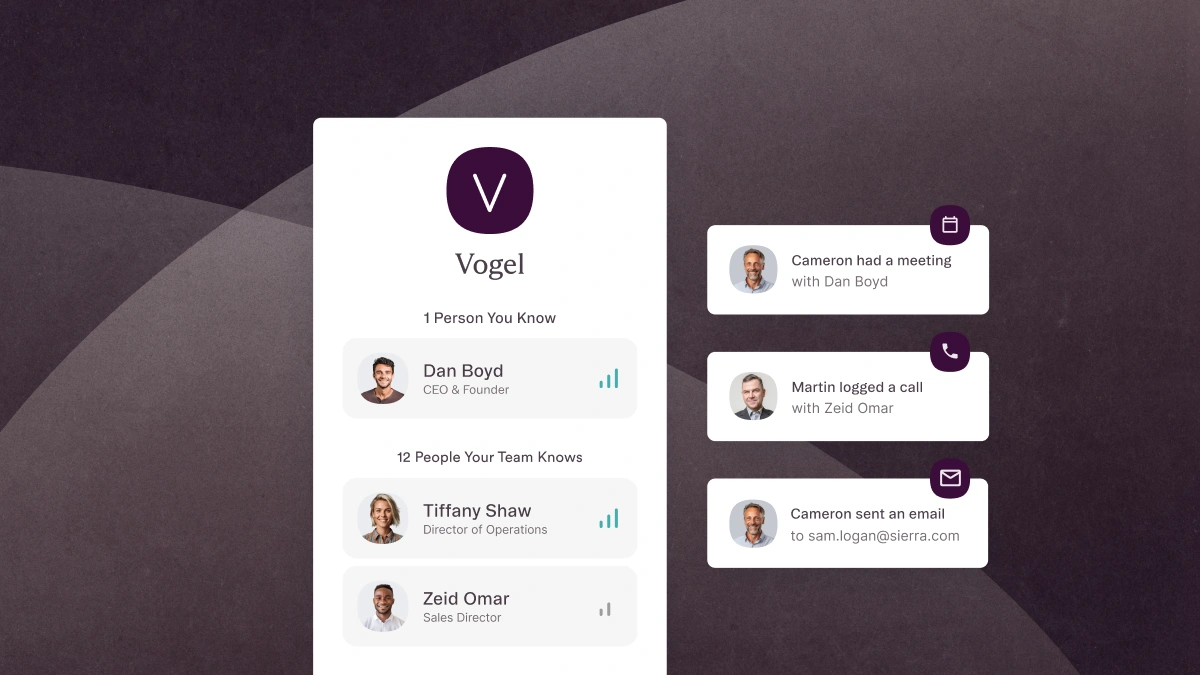
- Relationship intelligence. The platform shows your team's collective network: who knows whom, how well, and the warmest path to an introduction.
- Data enrichment. Company and people records fill in automatically with funding, headcount, and team data from trusted providers, so research starts from a complete record.
- Outreach. The software surfaces warm paths to founders, co-investors, and LPs, with reminders that keep relationships active between deals.
- Deal tracking. KPIs, job changes, and funding news sit alongside each deal, so a revisit two years later starts with full context.
- Document management and diligence notes. Tear sheets, decks, and IC memos attach to the company record, so the deal team works from one file during diligence. Notes can be private or shared.
- Portfolio and LP workflows. The CRM tracks portfolio support, introductions made, and LP engagement, even if another tool collects KPIs.
- Permissions and security. The vendor offers role-, team-, and deal-level permissions, audit trails, and certifications such as SOC 2 Type 2 and ISO 27001, which an institutional LP's security review will ask about.
- Integrations and APIs. The platform connects to email, Slack, document storage, data providers, and your data warehouse, so activity from the rest of your stack lands on the same record.
- AI that does specific work. The AI drafts meeting briefs, proposes record updates, or finds intro paths, and every change stays under human review.
How to choose venture capital management software for your firm
Choose venture capital software, or portfolio management software, on five factors: budget, integrations, how much data entry it removes, implementation risk, and security. Then test each vendor with the demo questions at the end of this section.
Budget
Pricing models differ by category, which makes side-by-side budgeting harder than it looks. CRMs and productivity tools usually charge per seat. Fund administration and portfolio monitoring tools may price by fund, by number of portfolio companies, or by assets under management. Market data providers typically sell annual licenses per user. Ask every vendor which unit its price scales with, include implementation, migration, and data add-ons, and model the cost at the team and fund size you expect in three years.
Integrations
Find out what integrations the venture capital management software offers. When your platform connects to your email, calendar, and messaging apps, information from every interaction gets captured. Check two more connections: whether your CRM can pull in your market data provider, and whether portfolio and fund data can flow into the same reporting.
Time spent on data entry vs. dealmaking
Relationships behind a single deal can span a few days or several years, and the data comes from many sources. Manual entry of all of it is slow and error-prone, and it creates silos between team members who need to collaborate quickly. That makes automatic data capture the first question to ask in any demo. To size the problem at your firm, try Affinity's ROI calculator.
"A lot of CRMs provide structured data management, but in the end we had to do the data entry ourselves, and that was a no-go for us. Affinity's automation and data enrichment meant we could focus on the thing that really matters to us: building relationships, gaining insights, and supporting the portfolio companies." — Sven Rossmann, Chief Investment Officer, Abacon
{{estimate-your-savings-plum="/rt-components"}}
Implementation and adoption
A CRM that stalls at go-live never collects the data you bought it for. Ask vendors how long firm-wide use takes, which comes well after technical go-live, and ask for a customer reference at your size. MassMutual Ventures, for example, implemented Affinity in less than 60 days with full integration.
Adoption fails the moment CRM work becomes manual overhead, so software that updates itself from email and meetings removes the main reason investors stop using it. For migration, ask whether the vendor offers an API and services to move historical deal and network data.
Security
Institutional LPs ask managers how they protect deal and relationship data, so your vendor's answers become part of yours. Before you sign, confirm certifications, the permission model, and how the vendor's AI handles and stores your data. Affinity is SOC 2 Type 2 and ISO 27001 certified, with permissions down to the individual deal and complete audit trails. See Affinity's security and trust practices.
Questions to ask in a demo
- How long does a firm our size take to reach firm-wide use?
- Which data is captured automatically, and which still requires manual entry?
- How does the platform show relationship strength and introduction paths?
- How are records enriched, and from which data providers?
- How do permissions work across funds, deal teams, and external partners?
- What does the AI do, and does any change happen without human review?
- Is our firm's data used to train models?
- How do we migrate historical data, and who supports it?
- Which tools in our current stack does the platform integrate with?
The best software for managing venture capital deals and operations
The best venture capital management software depends on the job it has to do. Use this table to shortlist one tool per category before you book demos, starting with the CRM.
| Tool | Category | Best for | Pricing usually scales with |
|---|---|---|---|
| Affinity | CRM and dealflow | Firms whose dealflow depends on relationships | Seats |
| Intapp DealCloud | Capital markets CRM | Larger, multi-strategy firms with ops resources to configure it | Seats |
| Salesforce | General CRM | Firms with in-house admins, or CVC teams on the parent company's instance | Seats |
| Navatar | Financial services CRM | Firms that want a private markets CRM on the Salesforce platform | Seats |
| Pipedrive | General sales CRM | Very small teams that want a visual pipeline | Seats |
| Airtable | Flexible database | First-time funds testing a process before adopting a CRM | Seats |
| Standard Metrics | Portfolio monitoring | Firms collecting KPIs from many portfolio companies | Funds or portfolio companies |
| Visible | Portfolio monitoring and LP updates | Emerging and mid-size funds sending regular LP updates | Funds or portfolio companies |
| Vestberry | Portfolio monitoring and analytics | Funds focused on portfolio analytics and LP reporting | Funds or portfolio companies |
| Carta | Fund admin and equity management | Firms that want cap tables and fund administration in one place | Funds or assets under management |
| AngelList | Fund admin and syndicates | Emerging managers outsourcing the back office | Funds or assets under management |
| Juniper Square | Fund admin and investor management | Funds that want an LP portal and investor reporting | Funds or assets under management |
| PitchBook | Market data | Diligence, valuations, and comps | Annual license per user |
| Crunchbase | Market data | Top-of-funnel screening and company research | Annual license per user |
| S&P Capital IQ | Market data | Analysts benchmarking public and private companies | Annual license per user |
CRM and dealflow management
Affinity
Affinity is the AI-first private capital CRM that turns relationship intelligence into action, built for the long, relationship-driven deal cycles VC firms run. Affinity is trusted by 3,300+ private capital firms and has 40% VC market share.
How it works. Affinity CRM captures activity from email and calendars across the firm and creates records without manual entry. It enriches company and people records from data providers including PitchBook, Crunchbase, and Dealroom, so a new company arrives with its funding and team history attached (PitchBook data requires your own PitchBook subscription).
Relationship Intelligence. Relationship Intelligence scores the strength of every relationship in your firm's network and shows the warmest path to an introduction.
Affinity Ascend. Affinity Ascend, the agent platform built for private capital, adds three agents, and your team reviews every CRM update before it's applied:
- Meeting Prep assembles a brief before external meetings from relationship history, deal context, and enrichment data.
- Data Update reads meeting notes and proposes CRM field updates for approval.
- Warm Intro maps routes to a named target and drafts the outreach.
MCP server. Affinity's MCP server brings your firm's relationship and deal data into AI tools like Claude, ChatGPT, Gemini, and Microsoft Copilot.
"Our team already works inside Claude all day, so having our CRM context available immediately in the same interface using Affinity's MCP connector just feels natural. Instead of digging through tabs before a meeting, we can ask Affinity for relationship history and recent interactions directly in Claude." — Joff Redfern, GP, Menlo Ventures
Best for: VC firms where sourcing, winning, and supporting deals depend on the firm's network. See how Affinity works for venture capital firms.
Intapp DealCloud
Intapp DealCloud is a configurable CRM and deal management platform for capital markets firms, including private equity, investment banking, and private credit. It's part of Intapp's broader suite of software for professional and financial services firms. Compare Affinity vs. DealCloud or explore DealCloud alternatives.
Best for: larger, multi-strategy firms with operations staff to configure and maintain it.
Salesforce
Salesforce is a widely used CRM for sales teams in industries like SaaS, retail, and hospitality. It can be configured for dealflow, usually with dedicated admin or partner resources that smaller VC teams lack. Explore Salesforce alternatives.
Best for: firms with in-house Salesforce administrators, or corporate venture teams whose parent company already runs it.
Navatar
Navatar is a CRM for private markets firms, from private equity and venture capital to investment banking, built on the Salesforce platform. It's known for pipeline management and investor relations workflows. Explore Navatar alternatives.
Best for: private markets firms that want a CRM on the Salesforce platform.
Pipedrive
Pipedrive is a web-based sales CRM with customizable dashboards for reporting on funnel stages. It's built around a linear sales pipeline, so firms that need relationship mapping or LP tracking typically add other tools. Explore Pipedrive alternatives.
Best for: very small teams that want a visual pipeline and little else.
Airtable
Airtable is a relational database that goes well beyond spreadsheets. Some emerging managers use it as a lightweight deal tracker or to organize due diligence before adopting a CRM. Because nothing is captured automatically, someone has to build and maintain it.
Best for: first-time funds testing a process before committing to a CRM.
Portfolio monitoring and LP reporting
Standard Metrics
Standard Metrics automates data collection from portfolio companies. VCs use it to run portfolio reviews, streamline LP reporting and valuations, benchmark investments, and reduce the reporting burden on founders.
Visible
Visible combines portfolio monitoring with investor updates. Firms use it to request metrics from portfolio companies and to build reporting for partners and LPs.
Vestberry
Vestberry is a portfolio management and reporting platform for venture capital funds, focused on portfolio analytics and LP reporting.
Edda
Edda combines dealflow management and portfolio monitoring in one product, which appeals to firms that want fewer vendors.
Fund administration and accounting
Carta
Carta is an ownership and equity management platform that venture firms use for back-office work. It brings together cap table data, fund administration, and company valuations, so firms can share current data with LPs and reduce manual entry.
AngelList
AngelList provides fund administration and infrastructure for venture funds, syndicates, and special purpose vehicles. It's a common choice for emerging managers who want to outsource the back office.
Juniper Square
Juniper Square offers fund administration and investor management software for private market funds, including LP portals and investor reporting.
Allvue
Allvue provides fund accounting, portfolio monitoring, and investor reporting software for alternative investment managers, typically larger multi-strategy firms.
Market data and research
PitchBook
PitchBook provides private market data, including pre-money valuations, deal histories, and investor profiles, for diligence, comps, and market mapping.
Crunchbase
Crunchbase helps investors search and track startups, funding rounds, investment trends, and other investors. It's a common starting point for early-stage screening.
S&P Capital IQ
S&P Capital IQ provides research and financial data on public and private companies, including valuations, financials, and security pricing, so analysts can evaluate deals in the pipeline.
Supporting tools
These tools don't run your dealflow, but many firms keep them in the stack:
- Scheduling: Calendly and SavvyCal for booking meetings without email back-and-forth.
- Email productivity: Mixmax for sequences, scheduling, and tracking inside Gmail.
- SaaS benchmarks: Public Comps for comparing ARR, retention, and payback period against public companies during diligence.
{{request-demo-short="/rt-components"}}
Which VC software fits your firm type?
The right VC software stack depends on fund size, structure, and who does the work. Emerging managers need tools that run without an admin, multi-fund firms need permissions and consistent reporting, CVC teams need privacy plus connections to the parent company, and analyst-heavy teams need enrichment and meeting prep.
Emerging managers and small funds
Small teams with no back office need tools that run without an admin. A common stack is a VC CRM with automatic data capture, plus AngelList or Carta for fund administration and Visible for LP updates. An expensive market data license is often the first thing to defer.
Multi-fund and multi-strategy firms
Firms running several funds need permissions by fund, team, and deal, plus consistent reporting across vehicles. They typically pair a CRM with dedicated portfolio monitoring and a market data subscription, and they add platform or operations staff who care about APIs and data warehouse connections. Some larger multi-strategy firms also evaluate DealCloud for its configurability.
Corporate venture capital teams
Corporate venture capital teams track strategic investments alongside relationships with business units, partners, and co-investors. They need deal data kept private while still connecting to the parent company's systems. Affinity offers packaged connections to Salesforce, Slack, and Box, plus APIs and direct integrations with Snowflake, Databricks, and BigQuery.
"Affinity creates visibility across teams, so if an investor chatted with someone, then folks from our portfolio development team can go into that company's profile in Affinity and see how long the two have been communicating and ask for an introduction. That is the relationship intelligence that we're trying to unlock and super-power within Munich Re Ventures." — Pedro Carrasco, Senior Operations Manager, Munich Re Ventures
Firms with analyst and associate teams
Analysts spend their days on research, screening, and meeting prep, so they benefit most from data enrichment and automated meeting briefs. In Affinity, enriched records and the Meeting Prep agent cover that groundwork, with PitchBook or S&P Capital IQ for deeper diligence.
What changes when data capture is automatic?
When data capture is automatic, the CRM updates itself from email and calendars, so investors stop logging activity and every review starts from a current pipeline. Compare a typical week before and after rollout:
| Before: manual CRM or spreadsheets | After: automatic capture | |
|---|---|---|
| Logging activity | Investors type in emails, meetings, and notes by hand | Email and calendar activity syncs to records automatically |
| Finding an intro | Ask around in Slack or the Monday meeting | See who knows the founder and how well |
| Meeting prep | Search inboxes and old notes before each call | A brief is assembled before external meetings |
| Pipeline review | Rebuild the spreadsheet before each partner meeting | Review a pipeline that's already current |
The results show up in hours and in coverage. Alpha Venture Partners saves 100+ hours per week collectively in manual data entry. Speedinvest tracks 10,000 leads per year in Affinity, and Notion Capital saw a 50% increase in annual companies screened. For Kapor Capital, the change was consolidation: 4 tools into 1 CRM.
What do top-performing VC firms do differently?
Top-quarter VC firms pull ahead of the median on relationship work, while their email volume looks much like everyone else's, according to Affinity's 2026 Venture Capital Benchmark Report, drawn from platform data across nearly 3,000 venture firms.
Top firms put more of their network to work
Network activation is the share of a firm's tracked relationships that turn into an introduction, and it separates firms more than any other benchmark. The median venture firm activates 38% of its network. The bottom quarter activates under 21%, and the top quarter clears 63%. For the median firm, well over half of its relationships never produce an introduction. A CRM that scores relationship strength shows which of those dormant connections are worth a call.
Relationships are the differentiator
The median firm makes 20 introductions per user per month, and the spread is the widest of any activity metric: 10 in the bottom quarter, 36 in the top. Email volume runs the other way. The median firm sends 1,094 emails per user per month, and the top quarter sends barely twice the per-user volume of the bottom quarter (1,580 vs. 750). Two firms can email at nearly the same rate and produce introductions at very different rates, a gap the report attributes to how well each firm's network is organized.
Relationship capital is concentrated
One person holds a median 29% of a firm's strong relationships, and the top three people hold 65%. If the most-connected partner leaves, roughly a third of the firm's relationship capital can leave with them, unless the CRM captured those relationships while that partner was still there.
Network growth pays off only when the network gets used
The median firm adds 37 new contacts per user per month, with the bottom quarter under 23 and the top quarter above 64. Read that number alongside activation, because new names only matter once they produce introductions.
AI adoption is accelerating
64% of investors now use AI to accelerate company research, according to Affinity's Venture Capital Benchmark Report (2025 edition). In Affinity's 2026 Private Capital Predictions report, the share of investors using AI for investment decisions more than doubled, from 13% to 28%. When evaluating software, look for AI that transcribes meetings, parses deal documents, and enriches records, so it removes data entry without adding another tool to manage.
Firms are consolidating their data stack
The same Predictions survey found that 47% of firms now use just 1–3 data sources, as the norm shifts from 4–6 sources toward a few core, integrated platforms. Fewer, better-connected tools mean less time reconciling data and more confidence that it's current.
Select software that works the way you do
The warm path to the next founder your firm wants to meet may already exist in someone's inbox. Whether the deal team can see it depends on whether your CRM captured the emails and meetings that built it. Affinity, the AI-first private capital CRM that turns relationship intelligence into action, captures your firm's network automatically, keeps your pipeline full, and shows the warmest path into every deal, so it can anchor your venture capital tech stack.
See how Affinity maps your firm's network. Request a demo
Frequently asked questions
What is the best portfolio management software for venture capital firms?
The best portfolio management software for VC firms combines deal pipeline tracking, portfolio company monitoring, and relationship intelligence. Commonly used platforms include Affinity (the AI-first private capital CRM, with relationship intelligence and deal management), Carta (equity management and fund administration), Edda (dealflow and portfolio monitoring), and Visible (portfolio reporting and LP updates). The right choice depends on whether your firm prioritizes front-office deal sourcing or back-office fund operations. Many firms start with a CRM that captures deal activity automatically, then add specialized tools for portfolio reporting and cap table management.
How do VC firms track their portfolio companies?
VC firms track portfolio companies using a combination of portfolio monitoring software, quarterly reporting workflows, and data integrations with financial platforms. Firms typically collect KPIs like ARR, burn rate, and runway directly from founders through standardized reporting templates, then centralize that data in platforms like Standard Metrics, Visible, or Carta. Firms managing larger portfolios often use CRM platforms with automatic activity capture to track every email, meeting, and introduction alongside financial metrics, giving partners a complete view of each relationship without manual updates.
What software do venture capital firms use to manage deal flow?
Venture capital firms use dealflow management software to track potential investments from first contact through due diligence to close. The most common approach is a CRM configured for deal tracking. Options range from purpose-built platforms like Affinity and DealCloud to customized Salesforce implementations and lighter tools like Pipedrive or Airtable. According to benchmark data from nearly 3,000 VC firms, the median firm turns 38% of its network into introductions while the top quarter clears 63%, which makes capturing and scoring relationships a priority. Alpha Venture Partners saves 100+ hours per week collectively in manual data entry after switching to software that logs emails, meetings, and contacts automatically.
What features should a VC look for in fund management software?
The core features to evaluate in VC fund management software are deal pipeline management, portfolio monitoring and reporting, LP communication tools, fund accounting, and data integrations with providers like PitchBook, Crunchbase, and Dealroom. Beyond baseline functionality, the most important distinction is whether the platform requires manual data entry or captures activity automatically. Firms tracking 10,000 leads per year, like Speedinvest, need software that logs interactions from email, calendar, and meetings without requiring the deal team to update records manually. Other factors include implementation time, mobile access for partners traveling between board meetings, and security certifications required by institutional LPs.
How does AI improve venture capital portfolio management?
AI improves venture capital portfolio management by automating data collection, surfacing patterns in relationship data, and reducing the time deal teams spend on administrative tasks. The most common applications in 2026 include meeting transcription, deal document parsing (extracting key terms from pitch decks and data rooms), company research summaries that pull from multiple data sources, and contact enrichment that keeps firm and founder records current. For portfolio management specifically, AI identifies which portfolio companies need attention by analyzing communication frequency, flags when key relationships have gone quiet, and surfaces relevant news or funding events across the portfolio.
How do you choose a venture capital CRM?
Choose a VC CRM on four criteria: automatic data capture, relationship intelligence, data enrichment, and permissions that fit your fund structure. Then check integrations, security certifications, and time to firm-wide adoption. Ask each vendor what's captured automatically and what still requires manual entry, because manual entry is where adoption fails.
How does Affinity compare to DealCloud for venture capital?
Affinity is built around automatic data capture and relationship intelligence, while Intapp DealCloud is built around configurability for larger capital markets firms. Affinity captures email and calendar activity automatically, scores relationship strength, and finds warm introduction paths, and it has 40% VC market share. DealCloud is highly configurable and part of Intapp's broader suite for financial and professional services firms, and it's often evaluated by larger, multi-strategy firms with operations resources to configure it. VC firms whose dealflow depends on the network usually weigh automatic capture and relationship intelligence most heavily. See the full Affinity vs. DealCloud comparison.
How do investors centralize diligence notes?
Investors centralize diligence notes by attaching them to the company record in their CRM, next to emails, meetings, decks, and IC memos. That keeps every finding in one place for the whole deal team. Look for a CRM that connects to document storage like Google Drive or Box and lets you mark notes private or shared.