How to create a valuable network


To create a valuable network, prioritize quality over quantity. Decide what you want your network to help you achieve, rate your relationships by how well they support that goal, and invest your time where it compounds. While some people think a valuable network is the longest list of names you can collect, it’s actually a smaller set of relationships you maintain and deepen with intention. The professionals who get the most from their networks treat them as a managed asset. In this article, we’ll show you exactly how to do that.
What you'll learn
- What makes a network valuable, and why size is the wrong metric
- Why a deliberate network matters for your career and your firm
- How to set a relationship objective that tells you who to invest in
- A four-tier system for rating and prioritizing the people you know
- The difference between strong and weak ties, and why you need both
- How investors and dealmakers turn relationships into dealflow
What is a valuable network (and what makes one valuable)?
A valuable network is a set of relationships that reliably connects you to the people, opportunities, and information you care about most. Its value comes from relevance and depth, not volume. According to Dunbar's number, we can only successfully manage around 150 relationships at a time, an approximate limit that varies from person to person.
That constraint is the point. Most networks hold thousands of names, but attention is finite. A large network you can’t maintain is just a list; a valuable one is the subset you know well enough to help, and who know you well enough to help back.
Why does it matter to create a valuable network?
A valuable network matters because the best opportunities rarely arrive through a cold application or a public listing. They arrive through people who trust you enough to think of you first. Referrals, introductions, and early information flow from relationships, not from reach.
The network is often the single most durable career asset you own. Roles and firms change, but a well-tended set of relationships travels with you. The cost of neglecting it stays invisible until you need it: the introduction you can't get, the deal you hear about a week too late. Building it before you need it separates people who seem lucky from those who are simply prepared.
How do you know your relationship objective?
You know your relationship objective by answering one question: when do you want people to think of you? Your objective is the context in which you want to be top of mind, and it becomes the filter for who matters most. You can't manage what you can't measure, and you can't prioritize relationships until you know what you're optimizing for.
Do you want people to think of you when they meet a promising startup? When they hear about a great sales role? When they come across a new biotech investor? The more precise your answer, the clearer every later decision becomes. Mindmaven calls this your relationship objective. It turns a vague ambition ("build my network") into a concrete test for each relationship: does this person get me closer to the outcome I named?
How do you rate and prioritize the people in your network?
You rate your network by sorting people into tiers based on how much they help you reach your relationship objective, then investing your time in proportion to each tier. Mindmaven, a company that teaches professionals experience-based relationship management, uses a four-tier system built on titles rather than numbers or letters, because titles stick in your memory and prompt action.
"Not everyone in our network provides the same amount of value or connects us to the opportunities we want to hear about most. By rating our network in the right way, we simultaneously avoid spinning our wheels or draining time unnecessarily and replace this with a clear blueprint of our network, focused on who should get the best from us in terms of frequency of touch and the value of interactions you deliver. In other words, we remove much of the ambiguity and ensure we invest time in the right ways."—Chalyse Elsasser, Coach at Mindmaven
The four tiers, per Mindmaven, are:
- Legends: The MVPs of your network. They give you the best exposure to the people, opportunities, and deals that align with your objective.
- Champions: Valuable in helping you reach your objective, but a notch below a legend for one reason or another. They may turn into legends in the future.
- Stars: People you know reasonably well and respect. You can call on them for a favor, but they won't move mountains to make you successful.
- Players: Everyone else. They make up the bulk of your network.
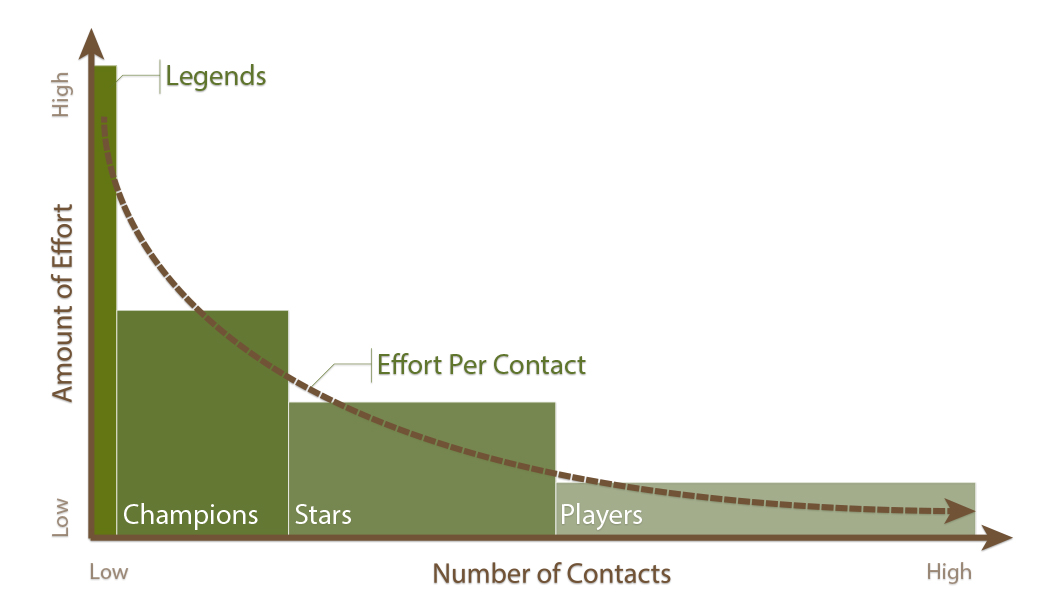
Be diligent about who you call a legend. Mindmaven recommends restricting the number of legends in your network to no more than 5% of your total network, or a maximum of 50 people. That is where your time and effort should concentrate, because legend relationships take the most work to nurture. Champions, stars, and players still get attention, just in proportion to their value.
What's the difference between strong and weak ties (and why both matter)?
Strong ties are the people you interact with often and trust deeply; weak ties are acquaintances you know loosely. Both are essential, and they do different jobs. Strong ties give you support, candor, and reliable help. Weak ties give you reach into circles your close contacts can't see.
Sociologist Mark Granovetter's 1973 "strength of weak ties" research found that weak ties are important conduits for novel information and opportunities. A 2022 randomized experiment published in Science provided causal evidence that weaker ties increased job mobility the most, while showing the relationship is nonlinear, with diminishing returns as ties get weaker. Your closest relationships tend to know what you already know, because you share the same world. An acquaintance two steps removed is far more likely to surface a role, a deal, or an introduction you'd never find otherwise. A valuable network keeps both alive: strong ties you deepen through consistent contact, and weak ties you keep warm so they reactivate when it counts. For more on expanding that outer ring deliberately, see our guide to how to grow your network.
How do you nurture and deepen relationships?
You nurture relationships by consistently giving attention and value before you ask for anything, especially to your legends. Mindmaven recommends several strategies to deepen the relationships that matter most. Three of the best:
- Be interesting by taking an interest in others. Get to know the people in your network. Ask questions that reach into their passions, drives, and interests, and then listen.
- Never fire off a question alone. A single question usually produces a bland answer. A follow-up leads to a more intimate, more engaging conversation. Try: "Have you always thought that way?" "Why is that important to you?" "How does that make you feel?"
- Seek out difficult, uncomfortable conversations. Hard conversations are part of any real relationship. Most people avoid them; the strongest networkers lean in, and are seen as more reliable and trustworthy for it.
"When we take care of our network in the right way, it enables us to reach our fullest potential. We're able to hear about opportunities we care about most. Some of the best opportunities, in terms of quality, come from people we know and trust in the form of referrals. Therefore, our commitment to take care of our network is absolutely critical to reaching the next level."—Chalyse Elsasser, Coach at Mindmaven
How do investors and dealmakers create a valuable network that generates dealflow?
Investors and dealmakers build dealflow by treating the firm's collective relationships as a shared asset rather than a set of private address books. At a venture capital, private equity, or investment banking firm, the best deals come through warm introductions, so the question expands from "who do I know?" to "who does anyone at our firm know, how well, and how recently?"
Answering that at firm scale is where relationship intelligence comes in. Relationship intelligence is the practice of understanding who knows whom, how well, and how warmly across an entire organization. Firms map their combined network, track the strength and recency of each relationship, and route warm introductions to the person best positioned to make them. A partner who wants to reach a hard-to-access founder can see that a colleague already has a strong, recent relationship, and ask for the intro instead of going in cold.
"One of our portfolio companies was prospecting, and the Affinity Pathfinder Chrome plugin allowed them to see that we had connections to one specific company they wanted to get connected to. We made the introduction, and they are now likely going to do business with one another."—Samantha Santaniello-Lawrence, Head of Platform, MassMutual Ventures
That is the difference between reacting to inbound deals and engineering proprietary access. For a deeper look at how firms turn scattered relationships into a single, searchable picture, see our guide to CRM network mapping. A CRM built for this can capture relationship activity automatically, so the map stays current without anyone maintaining it by hand.
"It's night and day. We are way more organized when it comes to relationships—everyone is on the same page. We've won a good amount of deals that we wouldn't have won if we hadn't changed over to Affinity."—Doug Parker, Head of Origination, Seaside Equity Partners
Conclusion
To create a valuable network, come back to three moves: know what you want your network to help you achieve, prioritize the relationships that move you toward it, and nurture those relationships with genuine, consistent attention. Size is a vanity metric. Intention is the multiplier. The professionals and firms that win over the long run are the ones who treat their network as an asset worth managing, not a list to grow.
As your network grows past what you can track in your head, the challenge shifts from building relationships to keeping them visible and current. That's exactly what relationship intelligence is built to solve: turning a sprawling web of relationships into a clear, actionable picture of who knows whom, so the next warm introduction is always within reach.
Frequently asked questions
What are the 5 P's of effective networking?
The 5 P's are commonly described as purpose, people, process, preparation, and persistence. Purpose is knowing what you want your network to do for you; people is choosing who to invest in; process, preparation, and persistence are the habits that turn one-off meetings into lasting relationships.
What are the different types of professional networks?
In a framework Herminia Ibarra and Mark Hunter developed from a study of 30 emerging leaders (published in Harvard Business Review), professional networks fall into three types: operational (the colleagues who help you do your current job), personal (peers, mentors, and acquaintances who support your development), and strategic (the senior, cross-industry relationships that shape your future opportunities). Most people over-invest in operational networks and under-invest in the strategic ones, where long-term value tends to live.
How do you build a network with powerful or senior people?
You build relationships with senior people by leading with value, not requests. Offer something useful first: relevant information, a thoughtful introduction, or genuine interest in their work. A warm introduction from a mutual connection dramatically raises your odds of a response, which is why a well-maintained network matters so much when you're trying to reach hard-to-access people.
How do you create a professional network from scratch?
Start by naming your relationship objective, then list the people you already know who connect to it, however loosely. Rate those relationships, reconnect with the most relevant ones, and ask for a single, specific introduction. A network compounds: each warm introduction expands your reach into circles you couldn't access alone.
Related Articles


Put your firm’s network to work