How PE firms use CRM at every stage of the deal lifecycle

Most private equity firms are all too familiar with these scenarios:
- A firm has been tracking a company for years, and when a teaser lands in a partner’s inbox, nobody at the firm can quickly identify a warm intro at the company.
- After an associate who's covered a banker relationship for months takes another job, the deal he was closing inherits a coverage gap nobody else can fill.
- A deal the firm passed on 18 months ago just sold to a competitor, and nobody remembers seeing it, let alone why they passed.
- At IC, someone asks how strong the firm's relationship with management really is, and the answer is a shrug and one partner's memory of a dinner eight months ago.
All four could happen in the same week, at the same firm. Often, they do. Every one of these is the same problem showing up at a different point in the deal. Relationships are the asset every PE firm says matters most, but few manage them with the same rigor they apply to anything else on the balance sheet.
That gap, between having relationships and being able to act on them, exists across the whole deal lifecycle. And closing it takes purpose-built infrastructure: relationship intelligence embedded in every workflow, proactive AI that takes busywork off the desk, and flexibility to extend deal and relationship data across a firm’s tech stack.
With that infrastructure in place, firms can turn relationships into a compounding asset. Their time shifts away from tracking, updating, and compiling, toward the work that actually requires judgment: building relationships, evaluating opportunities, and closing.
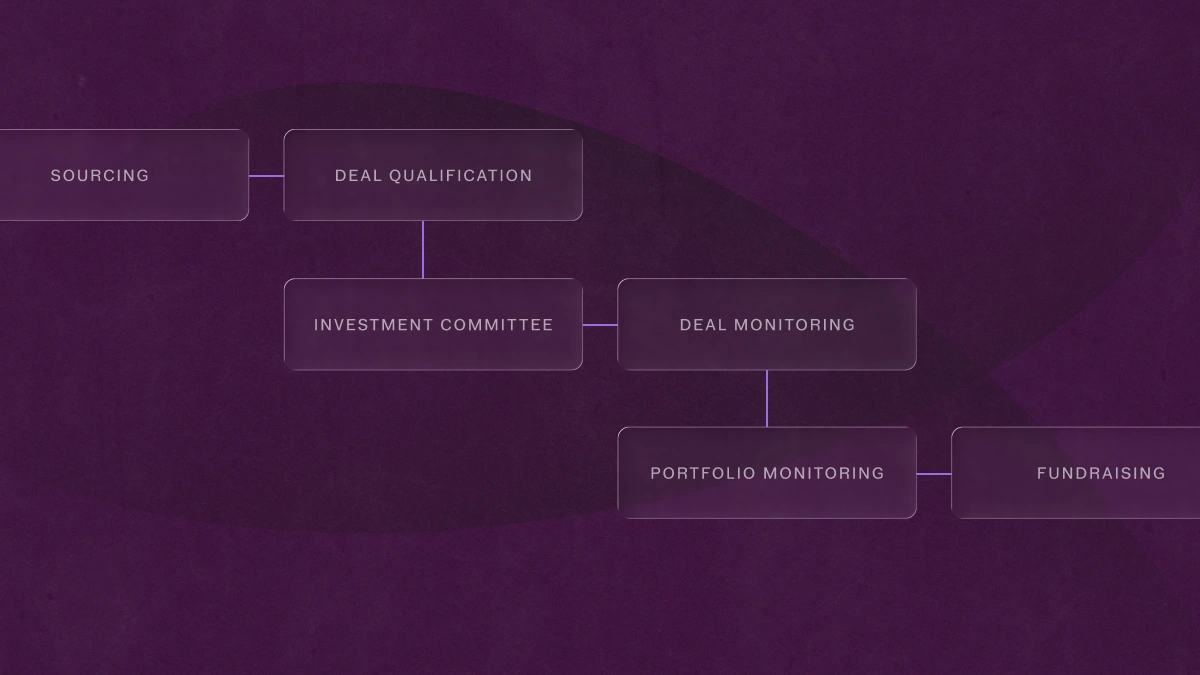
PE firms use a CRM at six stages of the deal lifecycle: sourcing, screening, investment committee, monitoring, portfolio monitoring and exit, and fundraising. Here’s where clunky systems and workflows break down, and how purpose-built infrastructure solves them.
Deal sourcing: finding the warm path in
In deal sourcing, a CRM shows a PE firm what it already knows about a target and who has the strongest path to its bankers and management.
The challenge:
It's Tuesday, and a teaser lands for a company nobody at the firm can place off the top of their head. A partner starts asking around: does anyone know this company, or know someone who does? Three people chime in with three different half-answers, but nobody can say with confidence where the firm stands, or who's got the best inroad.
Or there's no teaser at all, just a partner deciding cost containment is worth a real look. Building that list from scratch means hours of Googling, cross-referencing PitchBook, and digging through old deal folders trying to remember if the firm looked at something similar a year ago, because the tagging back then wasn't good enough to just search for it now.
Either way, there's no shared record of the firm's conversations and deal history to check against.
How leading firms operate:
Leading firms aren't smarter. They're just faster. When a teaser lands, they already know how familiar the firm is with the company and exactly who to call first, instead of spending a week asking around.
A thematic push doesn't start from zero either. It starts with what the firm already knows and tagged, and grows from there.
Either way, the network isn't tribal knowledge sitting in a few people's heads. It's something the whole firm can see and act on.
Motive Partners increased the number of deals it reviews annually by 66% after moving its coverage onto Affinity.
How Affinity helps:
Ascend's Market Map skill builds a competitive landscape from the firm's own data and a stated thesis, and Lists turns that into a live, tagged watchlist that's still searchable the next time this theme comes around. Warm Intro Agent surfaces the most direct path to a banker or management contact from the firm's own relationship data, instead of a partner cold-calling their network to find out, and Relationship Strength Score puts a number on how warm that contact really is.
Deal qualification: walking into the Monday meeting with the full picture
In deal screening, a CRM turns an incoming CIM or teaser into a brief that already reflects the firm's own history with the company.
The challenge:
On Wednesday, the 80-page CIM comes in the firm’s inbox. Before the Monday Morning Meeting, someone has to read it, cross-reference it against what’s already been logged on the deal, and turn it into something the partner can actually use. That usually means an associate spends the next few days skimming the deck for all the relevant details and compiling notes from across the firm.
How leading firms operate:
Leading firms don’t spend days building briefs. The moment a CIM or teaser arrives, it gets synthesized and cross-referenced against the deal’s own history automatically, so the partner walks into MMM with a full picture of the opportunity and the firm’s position.
How Affinity helps:
Notetaker generates diligence call notes automatically and attaches them to the record, so context is shared across the firm, ensuring no further rebuilding from scratch. And ahead of MMM, Meeting Prep Agent automatically builds a brief in minutes including relationship history, deal context, and all relevant touchpoints across the firm.
Investment committee: defending the relationship path
At investment committee, a CRM gives the room evidence of relationship strength with management and keeps sensitive deals visible only to the deal team.
The challenge:
It’s Thursday, IC convenes at 4pm, the deal memo is done and the numbers are solid, but when someone asks how strong the firm's relationship is with the management team, the answer is a shrug and a partner's recollection from one dinner eight months ago. Nobody else in the room has anything to check that against. And since it's a live take-private, half the room shouldn't even be hearing the details yet, but there's no clean way to keep the conversation to just the deal pod.
How leading firms operate:
Leading firms don't let the relationship context rest on one person's memory. IC can see the actual history: who's talked to the company, how often, how recently. And when a deal needs to stay quiet, it stays quiet, without anyone having to manage that by hand.
How Affinity helps:
Relationship Strength Score gives IC a scored view of how strong the firm's relationship path into the management team actually is, rather than a yes-or-no on whether one exists. Restricted Opportunities keeps a live take-private discussion visible only to the deal pod on the allow list, so MNPI exposure doesn't extend past the people actually read into the deal. And once IC actually decides, Audit Logging preserves the pass or pursue call and the reasoning behind it, instead of letting it live in a partner's notebook until the partner leaves.
Deal monitoring: keeping the relationship intact
Between signing and close, a CRM keeps banker and management relationship history with the firm when the people who built it leave, and records the deals the firm passed on.
The challenge:
On Friday, the associate who’s covered the banker relationship for eight months turns in his notice, two weeks before a live take-private is set to sign. Along with him goes the only real record of who said what to whom. When the deal finally closes and moves over to the portfolio team, they inherit a company with almost none of the relationship history that got it there.
A deal the firm passed on 18 months ago just got bought by a competitor, and nobody at the firm remembers seeing it, let alone why they passed. There's no way to check whether the firm actually saw every deal in its thesis, or just the ones that happened to land in someone's inbox.
How leading firms operate:
Leading firms don't let a sensitive deal's history live in one person's head. The relationship record stays with the firm through signing, through close, and through the handoff to whoever manages the company next, restricted to the right people the entire time, not lost the moment someone changes roles or leaves. They also track what they didn't do: deals passed on, and what happened to them, so 'we had good coverage' is something they can prove, not something they assume.
Invus Opportunities now covers 40% more of its deal flow than it did on its previous CRM.
How Affinity helps:
Relationship Intelligence preserves the banker and management-team relationship history automatically when someone leaves, so it stays with the firm instead of the person. Restricted Opportunities keeps a take-private masked from everyone off the allow list through the highest-MNPI-risk window, while still counting in aggregate pipeline totals. CRM Data Export Restrictions stop a departing VP from taking years of banker coverage out the door as a spreadsheet.
Opportunity lists, MCP/AI chat, and reporting aggregate a firm's historical deal activity against its thesis, keeping a record of every deal it saw, including ones it passed on or a competitor won, so coverage against the thesis is something the firm can point to, not just recall.
Portfolio monitoring and exit: catching cold relationships early
During the hold, a CRM flags portfolio relationships going cold and maps the firm's paths to buyers before an exit process starts.
The challenge:
A portfolio company's CFO left two quarters ago, and nobody on the deal team noticed until the board meeting, when the new CFO asks who they're even talking to at the firm. Eventually the same company heads toward an exit, and a banker gets engaged to run the sale before anyone at the firm has actually mapped which buyers it has a relationship with.
How leading firms operate:
Leading firms don't wait for a quarterly review to find out a relationship's gone cold. They know which portfolio companies need attention before the board meeting, not during it, and they can spot a follow-on or add-on opportunity the same way. And when it's time to sell, they already know which buyers they have real paths to, instead of building that list from zero once a banker's already on the clock.
How Affinity helps:
Relationship Intelligence surfaces follow-on and add-on opportunities through actual relationship data across the portfolio, instead of a quarterly review turning up what everyone half-remembered. Warm Intro Agent surfaces intro paths for executive search and value-creation needs across the portfolio, instead of a partner cold-calling their network for a CFO referral. Reminders & Actions flag a portfolio company with no recent touch before it becomes a coverage gap ahead of a board meeting. Once a sale process starts, that same Warm Intro Agent maps buyer relationships before the banker is even engaged, and Restricted Opportunities gives the deal-level and fund-level privacy an MNPI-sensitive exit needs.
Fundraising and LP relations: ready for the re-up
In fundraising, a CRM applies the same warm-path sourcing to LPs and keeps a running record of every LP touchpoint ahead of the re-up.
The challenge:
Sourcing a new LP looks a lot like sourcing a new company: map the universe, build a target list, find the warm path in. The difference is what happens after they say yes. An LP that's in the fund is worth protecting the way nothing else in this stage is, since losing one doesn't just cost a relationship, it costs a seat at the next fund.
An LP calls to ask about the fund's last conversation on a re-up, and the IR lead spends twenty minutes digging through old emails to reconstruct what was actually promised. Nobody logged the touchpoint in real time, and now a quarter of the relationship has to be rebuilt from memory under a deadline.
How leading firms operate:
Leading firms source LPs the same deliberate way they source deals, mapping the universe and building toward a warm path, not waiting for inbound interest. And once an LP relationship exists, they don't treat it as an afterthought. Every touchpoint gets logged as it happens, so the IR team walks into a re-up conversation already knowing the relationship's history, instead of assembling it after the LP calls.
How Affinity helps:
The same relationship intelligence that surfaces a warm path to a company surfaces one to a prospective LP, so outreach starts warm there too. Meeting Prep Agent builds the LP meeting brief from relationship history and prior commitments automatically, so an IR lead isn't assembling it from memory. Reminders & Actions logs and tracks every LP touchpoint automatically, instead of the IR team reconstructing a quarter of activity right before re-up season. Data Warehouse Shares pulls historical relationship and deal data into the fund's own warehouse for LP reporting and benchmarking so an analyst isn't exporting and reformatting it by hand every time a report is due.
And Affinity's security certifications—SOC 2 Type II, ISO 27001, GDPR—give the firm something concrete to point to when an LP's operational due diligence questionnaire asks about the vendors handling its data, instead of compliance vouching for a vendor it can't actually audit itself, or a DIY CRM with no outside audit behind it at all.
One relationship record, from first teaser to the next fund
Go back to that week. To the teaser nobody could place, the CIM that ate an associate's week, the IC question nobody could answer, and the resignation two weeks before signing. Initially, these looked like four separate problems. And for most firms, that’s exactly what they are, with a different inbox, spreadsheet, or partner holding each piece.
In fact, it’s one relationship record at different points in its life. The banker who sent the teaser is the path IC wants evidence of, the coverage the portfolio team inherits at close, and one of the first calls when the company comes back to market. When that record stays with the firm and keeps itself current, each stage starts where the last one ended: the warm path found in sourcing becomes the proof at IC, the history kept through a departure becomes the portfolio team's starting point, and the buyer map built over the hold is ready before a banker is engaged. By the time the next fund is raising, the IR team is working from the same record.
That's how relationships compound. Every deal the firm works makes the next one faster to source, easier to defend at IC, and harder for a competitor to win.
Ready to see how Affinity works for PE firms? Schedule a demo with our sales team.
Related Articles


Put your firm’s network to work