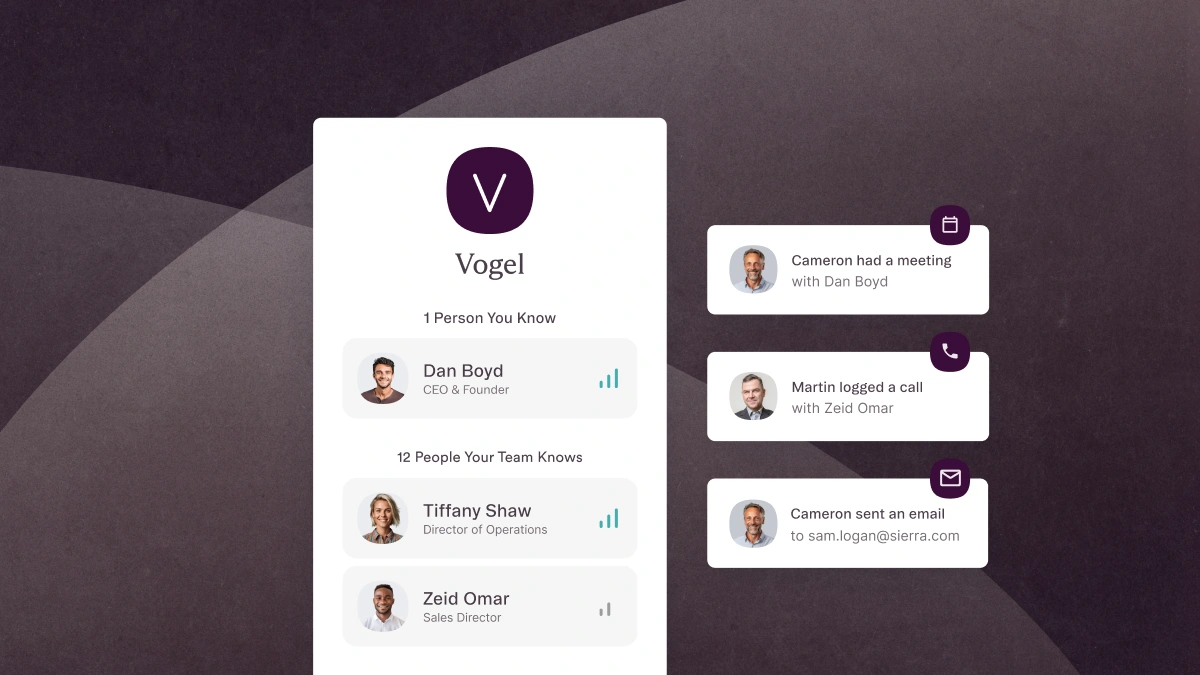
Turning your CRM data into relationship intelligence


Is your current CRM losing you mandates?
Investment bankers are measured not only by the deals they’ve closed but by their potential for closing new ones. This makes long-term business relationships paramount: a relationship economy in which connections become currency.
Your firm works with a wide range of hyper-specialized industries and deals, with founders and owners who commit to large financial—and often personal—decisions. Fostering long-lasting relationships that form the foundation of your long-term dealmaking strategy requires technology that can support and track those relationships.
The months- or years-long relationship-building that supports your mandates isn’t a transactional, short-term sales cycle. That’s why investment banking has turned away from legacy customer relationship management (CRM) technologies that are built for industries like SaaS, retail, and hospitality—not banking.
The future of customer relationship management
Firms are gravitating toward a new type of CRM platform that simultaneously frees them from manual information management, gives teams confidence in the accuracy of their data, and allows them to leverage that data to gain new insight into their highest-impact relationships.
In this guide, you’ll learn about valuable innovations in customer relationship management technology that can:
- Accelerate new client acquisition
- Automate data entry and dealmaking workflows
- Increase revenue
- Ensure you’re spending more time on high-leverage initiatives
- Help you close more mandates more quickly
The dangers of a disorganized professional network
Do your individual team members store client information in sales-focused, spottily used CRMs, on static spreadsheets, or on sticky notes? Or worse yet, do they simply hope they’ll remember it? If so, valuable data is getting lost.
In what can be a years-long competitive business development cycle, a dinner meeting tonight maybe the start of a deal that closes years in the future.
A Post-It note with “call them later” written on it won’t survive to the end of that process. This kind of system simply isn’t sophisticated enough to match the value of the deals you entrust to it.
Eliminate manual data entry for good
Waiting until the next day to type a note into a spreadsheet or jotting it down on scrap paper leads to incomplete and out-of-date records. This, in turn, creates disparate, disconnected data sources that lead to lost information, wasted time, and taking action without knowing about other, parallel efforts—ultimately creating a poor client experience and putting your firm’s brand at risk.
When your team depends on manually managed, scattered sources of independently owned information, your collective network remains invisible. Shared connections are overlooked, introductions remain unseen, and these missed opportunities can result in lost business.
If your data sources are scattered then your professional network is invisible.
Let an intelligent CRM manage your networking intelligently
As investment teams seek ways to build out reliable, widely adopted workflows for managing their growing professional network, many are relying on a new type of system to remember networking details for them.
Intelligent CRM platforms—systems driven by relationship intelligence and automation—are changing the way bankers are managing and closing mandates.
Intelligent CRM platforms are built to provide deepinsights into your team’s institutional memory and dealmanagement. Relationship intelligence—the technologythat enables the CRM to provide these insights—is theresult of several key features.
On its own, relationship intelligence is the insight intoyour team’s network, business relationships, and customerinteractions that helps you find, manage, and closemandates.
These insights are generated by AI-driven algorithms that analyze data from every email, meeting, and interaction between your organization and every business contact you’ve engaged with. These are then combined with enriched datasets from third-party sources to create a complete understanding of your professional network.
An intelligent CRM gives your dealmaking momentum
The “intelligence” includes things like who on your team has the best relationship with a contact who can advance a mandate; whether anyone on your team knows anyone at a target organization; and whether that organization has made new hires with whom your firm can build new relationships.
Relationship intelligence puts the momentum behind your dealmaking—and it underlies the difference between transactional sales and doing business successfully in the nonlinear way that investment bankers work.
Investment banking is not transactional—why should your CRM be?
Closing the technology gap
As investment competition continues to intensify, your team has to get to the right opportunities and relationships sooner than ever. There isn’t time to take action on a sketchy deal or based on incomplete or missing information. Trying to keep pace with these deals isn’t easy.
Downward pressure to keep business costs low while consolidating efforts and tools—and simultaneously improving the client experience for a growing client base—presents challenges that legacy platforms simply can’t keep pace with.
Aging platforms are lagging behind while your business grows toward the technology-driven, hybrid workforce of a future that’s already here. Getting—and staying—ahead of the competition for both new clients and new talent requires infrastructure changes that revolutionize how you work without disrupting your day-to-day.
To do this, the most successful investment firms are relying on new technologies to nurture their existing relationships, surface shared connections and new opportunities, and tell their story by analyzing the insights that would otherwise remain buried in a traditional CRM.
Legacy CRMs can’t keep pace with the speed at which you do deals.
Relationship technology for the relationship economy
Relationship intelligence doesn’t simply materialize. It is carefully derived from the data stored in your team’s intelligent CRM.
In order to maintain data integrity and and ensure the insights provided help you take action toward your next close, truly relationship-driven CRM platforms rely on:
1. Automation to capture and organize your team’s “data exhaust”—details automatically pulled from email communications, calendars, and contact information such as names, roles, industry, and source of introduction—to effectively eliminate the need for entering information manually.
2. Enriched datasets that provide greater context for every relationship in your organization’s professional network.
3. Comprehensive analytics and reporting tools that empower teams to make more accurate, data-driven decisions.
4. Intuitive, user-oriented interface design that ensures a CRM becomes a trusted source of truth because it is easy to use and keep up to date.
All of these elements combine to manifest an intelligent CRM with well-maintained, comprehensive records of every connection in your team’s network.
Powered by these insights, your team can focus on the high-impact relationship-building that will help your business grow—and automate the otherwise time-consuming data management.
Eliminate data silos and improve existing relationships
The potential for your next deal already exists in your CRM—that is, if your relationship data is up to date.Staying on top of every important relationship across your business is essential to creating sustainable business partnerships, but it can be difficult to keep up with these connections when your system of record feels like an empty warehouse.
Teams that rely on manual data entry risk losing—and losing out on—valuable institutional knowledge about their relationship network. When information is siloed, important details may be localized with a single member of your team—limiting access to a select few and making your firm a collection of individuals rather than a single team working together to build relationships.
Your next deal is already in your CRM.
Using relationship intelligence to nurture the right connections
In an industry like investment banking, where a successful deal today may pale in comparison to—and evolve into— a much larger mandate down the road, consistent engagement with all of your prospects is invaluable. Relationship intelligence helps dissolve information silos to increase team-wide visibility, while privilege-based privacy settings enable you to keep proprietary information safe.
Collaboration and privacy
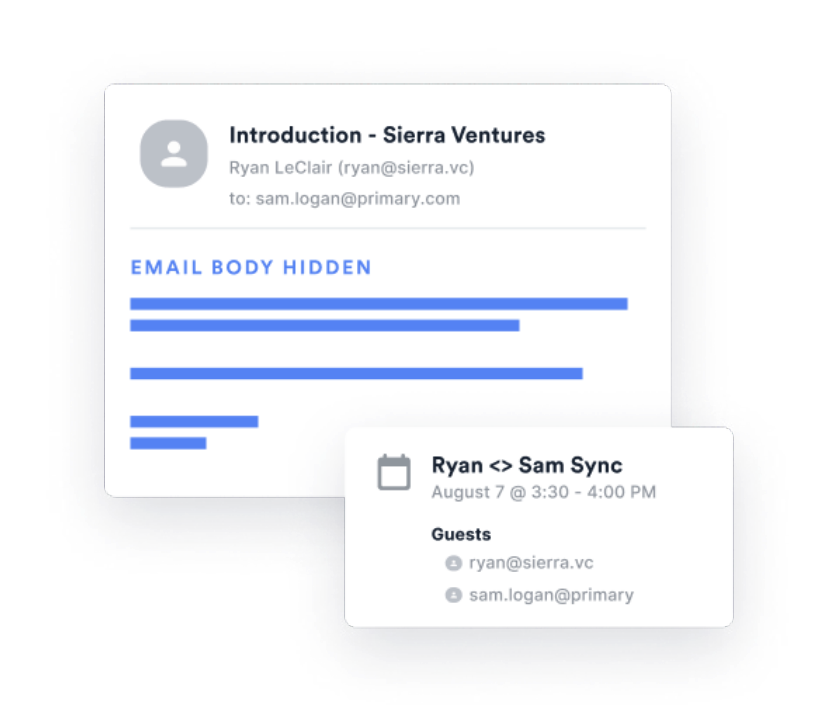
A purpose-built investment banking platform gives your team the ability to choose which emails are synced, who can view the details of a meeting, and who can access which files. By breaking down barriers to communication but retaining privacy screens, everyone on your team with approved access can see the complete history of your firm’s interactions with any contact.
Anyone can continue where someone else left off because all historical business activity has been accurately preserved. Relationships become common currency, not a single individual’s private cache.
Automation is freedom
By automating data capture from emails, phone calls, and calendar events, and housing it in a single system, you can be freed from data drudgery and have more time to cultivate meaningful relationships. Taking automation a step further, you can set reminders to schedule followups, so you remember to follow up with the contacts who matter most.
Automated data capture frees your time for dealmaking.
Accurate data lets you collaborate and do business with confidence
Staying connected to existing contacts can be difficult without the right tools, but finding and beginning new business relationships can be even harder.
The same data silos that thwart nurturing connections are also walls between your team and new deal opportunities.
Efficient knowledge-sharing helps your team move inharmony so they can do complementary—rather than overlapping—work.
Utilizing every avenue in your professional network to drive toward your next mandate requires that your team understands who owns what.
Collaborative teamwork includes:
1. Sourcing introductions within your intelligent CRM without accidentally overreaching and connecting with a prospect someone else is already working with.
2. Learning who on your team can provide a warm introduction to a prospect in their network.
3. Centralizing your mandate pipeline management from pitch to close so that deals are easily visible and shareable.
Teams supported by relationship intelligence are able to more effectively collaborate and make use of a collective network to accelerate new client acquisition.
Relationship intelligence surfaces shared connections and new opportunities
With your historical and current business relationships automatically captured in your CRM, the platform can begin to analyze your connections and equip your team with actionable insights to accelerate your pipeline of mandates. Improved collaboration starts with detailed relationship scoring.
By quantifying how well every member of your team knows prospects in your network, relationship scores take the guesswork out of deal sourcing and make it easier than ever to find a connection to a champion that can win you the mandate.
Ideally, your CRM will then integrate your own data with enriched data sources to expand your team’s knowledge by providing further context for every relationship in your network. With these additional insights, you can source new deals based on accurate, comprehensive records and be the first team to connect with a new opportunity by capitalizing on a warm introduction.
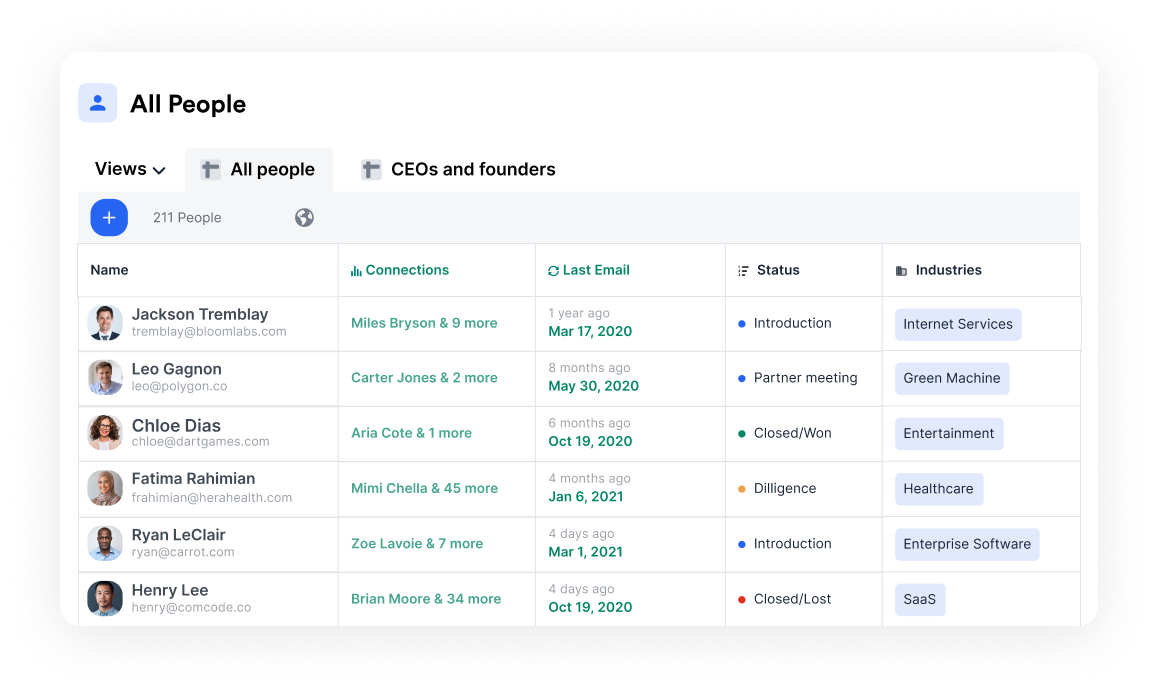
Merging disparate data sources into a single source of truth is becoming table stakes for investment firms.
Eliminate data silos and improve existing relationships
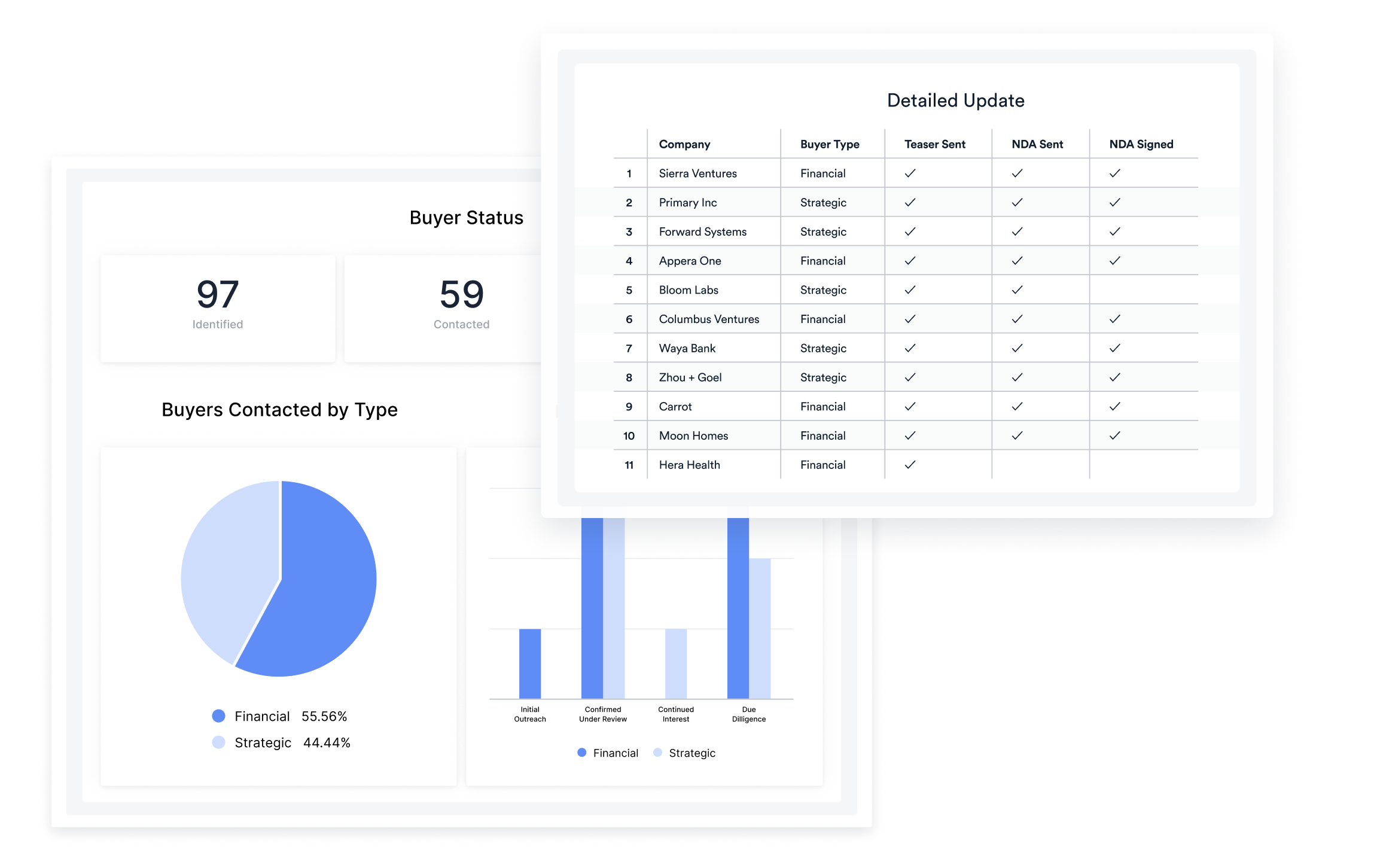
Data integrations may be a requirement for investment banks, but simply having that data is not enough. Your team also needs tools to review, analyze, and act on that data. When senior leaders request updates on your team’s largest deals, team members who are missing key organizational insights provided by an intelligent CRM don’t have a complete story to tell.
Increasing revenue and growing your firm’s mandate pipeline depends on collecting and analyzing the patterns and practices of client sourcing, client status updates, fees, pitch success rates, and other key business drivers.These data points allow you to establish, analyze, and report on KPIs and goals related to pipeline performance, productivity tracking, and industry insights aggregated from your intelligent CRM’s datasets. With new insights into performance and sourcing patterns, you can identify even more ways for your team to find key leads.
Analytics on how your team works give you insights into how your clients are responding.
Using analytics to tell your story
A comprehensive analytics dashboard can visualize wherein your pipeline mandates are getting lost and help you create accurate KPIs and revenue projections based on historical and current performance. Delving into the details of specific accounts offers an additional layer of detail into exactly which types of accounts and deals have proven successful.
With complete reporting tools, you can show up to your next client meeting with an easy-to-understand dashboard of your history with similar companies and prove that they can trust your team to manage the purchase or sale of their business.
No matter whom you meet, communicate the most important parts of the story of your business and prove that your firm can meet and exceed expectations.
Affinity: The relationship intelligence CRM platform
Do more business
Investment banking is driven by the connections between your team and the deals that define your firm. Affinity’s Relationship Intelligence CRM is purpose-built for investment banks and enables your teams to leverage their personal networks—and one another’s—to find, manage, and close mandates faster, all with software that every team member will find easy to use.
Protect your brand and all your data
All of this comes together to protect your firm’s brand equity. Reliable, comprehensive information about your relationships and opportunities removes the risk of overlapping work or stepping on your colleagues’ toes, while your data is securely protected according to strict security protocol standards including GDPR compliance, SEC approval, and SOC 2 Type II. The platform also gives you complete control over what data is captured and to whom it is visible with fine-grained controls built directly into the platform.
Free yourself from data drudgery
Once onboard, the platform can automatically capture the “data exhaust”—details pulled from email communications, meetings, and contacts—of every relationship you’re managing. You can be sure your relationship and deal data is complete, and your team can move confidently, armed with actionable insights.
Know more about your business network
Detailed, AI-driven insights provide a thorough understanding of your team’s collective network, quantifying and scoring the quality and depth of those relationships and moving you beyond the simplistic kind of knowledge of who knows whom provided by traditional sales CRMs.
Collaborate with confidence
Affinity provides your organization with complete, end-to-end visibility into your mandates, so you can centralize and simplify managing your pipeline—from pitch to close—with repeatable, standardized workflows to keep mandates organized and on track. And you can do this quickly; Affinity is lightweight and can be implemented more easily than other CRMs—often within just a few days.
Use relationship intelligence to your advantage
When your most important deals are supported byAffinity’s Relationship Intelligence CRM, you can make your team more efficient and provide in-depth insights into every opportunity—so you can connect with confidence, show up smarter, and close your next deal faster.
The Affinity Advantage
- Purpose-built for investment banks and the way they manage relationships
- Automated data capture obviates manual data entry
- Easy to use and quick to implement
- Familiar visualizations of productivity and pipeline analytics
- AI-driven relationship scoring provides the warmest introductions
- Transparent, centralized pipeline management
- Compliant with the highest-level security protocols