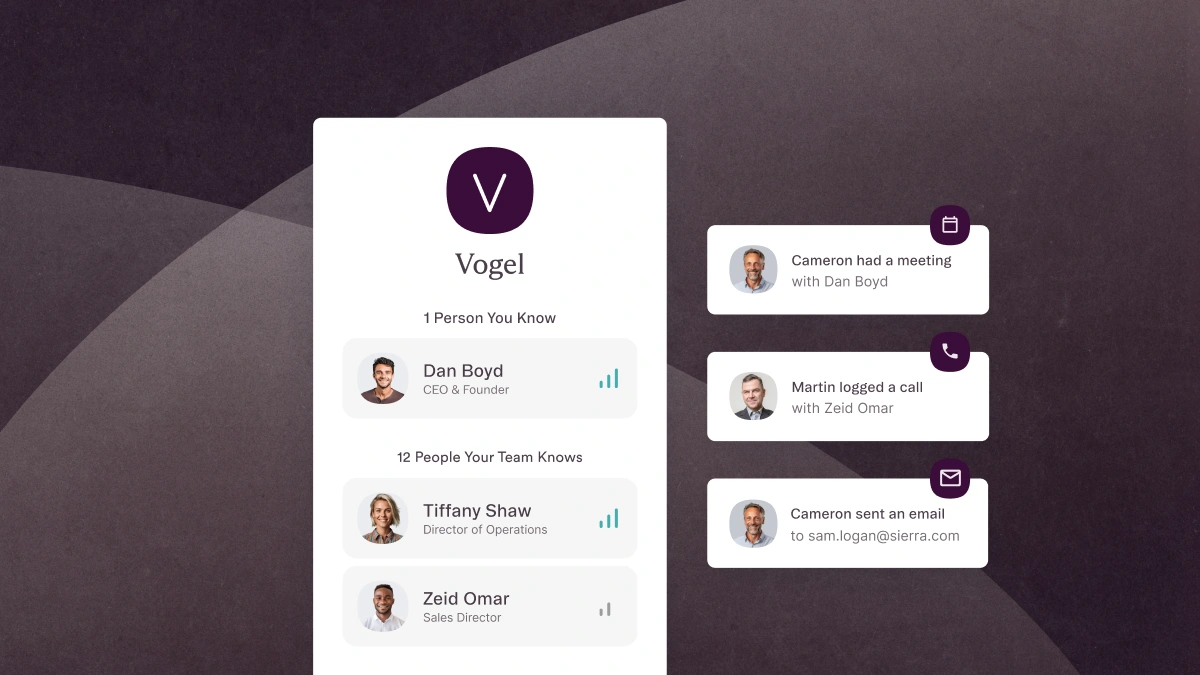
The definitive guide to CRM for consulting


A Customer Relationship Management (CRM) solution for consulting has to be efficient, easy to use, and built for business development. This means that yourCRM should be purpose-built for business development and enable teams and partners to find, manage, and close deals faster.
The right CRM is more than a deal management or record keeping tool, it’s a platform that provides deep insight into the complex relationships that drive your business. Whether your business development is led by a team of two or two thousand, having a centralized place to track and manage your clients and deals gives your firm the ability to collaborate on sophisticated, relationship driven opportunities.
As a growing number of potential clients embrace digital change, today’s consulting firms have to both understand and adopt technologies to differentiate themselves from the competition. Let’s explore what that technology looks like in your CRM.
What are the unique requirements of a CRM for consulting?
Traditional, manually managed CRM solutions are meant to support your team, but data entry and management just becomes another task on your team’s to-do list. Because of this, traditional solutions can slow teams down and aren’t optimized for the unique needs of consulting.
Automating data entry and improving collaboration across your team ensures your entire firm is working together to drive business development and build client relationships that will last beyond a single project.
This all means that consulting CRM platforms have to do more than just manage the business development process, they have to accelerate it.
Consulting CRM software supports these requirements with new technology-based solutions, including relationship intelligence, automatically synced contact and activity records, and automatic data entry.
Here are some key requirements for consulting CRM platforms to keep your team ahead of the competition:
- Accelerating business development.
- Creating more efficient, more impactful client communication.
- Automatically tracking and managing contact and deal data in a single source of truth.
- Encouraging adoption and use across your team.
How does a consulting CRM enable business development?
Your CRM has to do more than store contact information, it has to serve as a full, end-to-end business development platform. Today’s clients are more likely to turn to consultants they have worked with in the past—ones that have a proven track record of success—rather than pursuing new firms for their next project.
Effectively building and supporting your relationships and tracking progress on outstanding opportunities in one place makes sure every piece of relevant information stays tightly connected.

Engaging prospective clients
It’s more difficult than ever to stand out from the competition and prove yourself to prospective clients.An intelligent CRM helps scale your BD processes as competition in the consulting market increases and a greater number of niche consulting firms become available to your prospective clients.
Relationship intelligence (RI) algorithms provide insight into your team’s collective network, so you can find who on your team may be connected to a prospect. With RI you can reach out through a warm introduction instead of a cold email. Additionally, by automating data entry—especially the high volumes of data that come with sourcing and outreach—you can ensure your high-value team members are focusing on high-value activities instead of logging contact information by hand.
Supporting and retaining clients
Once a client’s in the door, your team’s successes are dependent on your ability to deliver results, and clear, efficient communication helps you create more transparent relationships to do just that. Automatic activity tracking helps you stay on top of your most valuable partnerships.
That way, even if your BD team hands a connection over to a project team, they always have the context they need to provide updates and keep your clients informed of your progress. Even if your direct contacts leave a team, building and maintaining a lasting record of your relationship with them in your CRM helps retain their loyalty to your service.
Consulting CRMs with data partnerships combine automatic data entry and data enrichment, so you can know if an important contact makes a change—and opens up anew opportunity
Activity tracking and automated data entry can help track:
- Last date of contact
- Any meetings your team has had with a contact
- Any emails sent to or from the contact
- Any relevant notes (e.g. additional information on a contact’s preferences of communication style or personal details like interests or hobbies)
- Files connected to their account (e.g. contracts)
- Related companies
- Related opportunities
Building a better opportunity pipeline
What work is your team doing to convert your leads into opportunities? How are you identifying inefficiencies in those workflows and improving them to decrease your time between a warm introduction and a closed deal.
Creating, tracking, and managing your opportunity pipeline as a team in your CRM can help answer these questions.As a result, you can scale and speed up your business development efforts.
Creating, tracking, and managing opportunities
Managing your active opportunity pipeline across disparate spreadsheets and email inboxes quickly turns your team’s potential projects into a disconnected mess of data. Consulting CRMs supported by automatic data entry help track relevant information tied to your deals.
It also provides the space to manage every deal together, creating complete visibility into how new opportunities are progressing and the chance to reflect on your complete business development process.
Creating repeatable successes
When data is siloed, organizational best practices end up locked away and deals remain tied exclusively to their initial point of contact. Increasing visibility into opportunities across your organization means your team is always aligned and can provide additional support when needed.
Additionally, automatically updated records standardize the data your team records and how it’s recorded. Consistency across your organization ensures your BD team can grow by relying on repeatable processes.
With more manual tools, your firm’s high-value, institutional knowledge and processes get trapped in independent spreadsheets or lost in email inboxes.
"With Affinity, there’s no friction. It’s hard to imagine going back to our olds ways to search and discover relationships among our companies."
- Robert Haines, Partner at Founders Intelligence, a Founders Family Company
4 key reasons consultants need a CRM for pipeline management
- Instantly see every deal in a single view, and drill down to view details on each of them
- Show, communicate, and manage those deals visually
- Automatically capture every status and communication related to a deal to enrich contact records
- Enhance records and expand the team’s collective network with relationship intelligence
Key technology requirements for a successful CRM deployment
Consulting CRM software is all about driving business development. Here are four specific technologies that set today’s consulting CRM platforms apart from traditional CRM solutions:
- Relationship intelligence algorithms expand your team’s available network and create new opportunities for you.
- Automated data entry captures the data related to these new connections.
- The new wealth of data creates a place for your team to easily collaborate.
- Built-in data visualization tools empower you to analyze and optimize your processes as you scale.
Let’s take a more in-depth look at how to effectively use these technologies to maintain quality information, gain new insights, and turn those insights into action with your new CRM.
Relationship intelligence
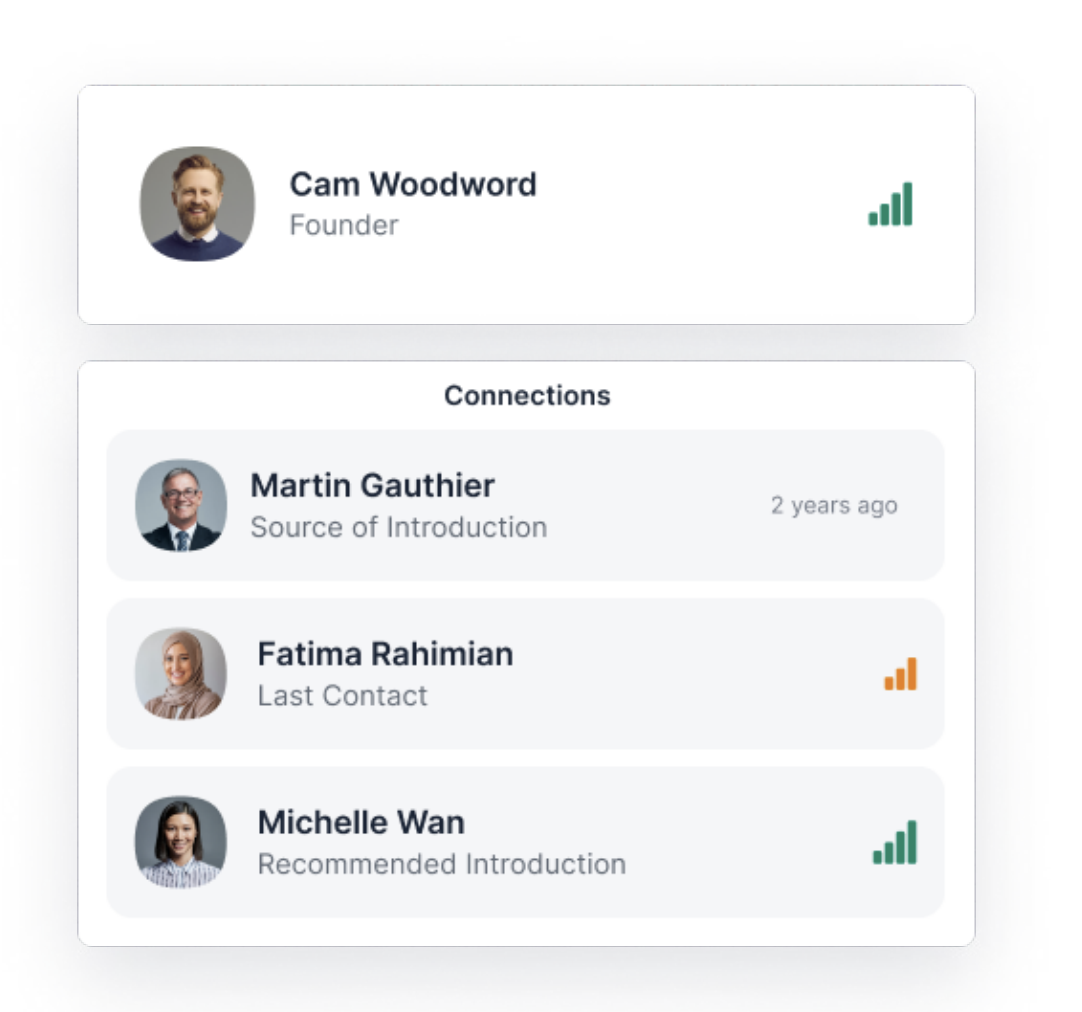
Relationship intelligence algorithms allow you to access new connections and understand who knows whom at a glance. Traditional CRM solutions can quickly become outdated (especially as people change roles) and relationships can become lost.
Being able to see your entire network of connections across your organization with quantified relationship scores eliminates the need to ask questions like “Do we have any connections to this team?” or “Who is the best person on our team to follow up with them?”
At a glance, you can rely on a smarter CRM to find the right person for every deal. This also goes beyond relationships with prospective clients.
Surfacing connections to relevant subject matter experts means you can also support existing clients faster by providing them with insights they need from the best experts available.
"Our database in Salesforce had seven or eight thousand emails in it. When we moved over to Affinity, on day one–after our seamless integration process–our active contacts inventory grew to 17,000"
- Michael Lamm, Co-Founder and Managing Partner, Corporate Advisory Solutions
Automation
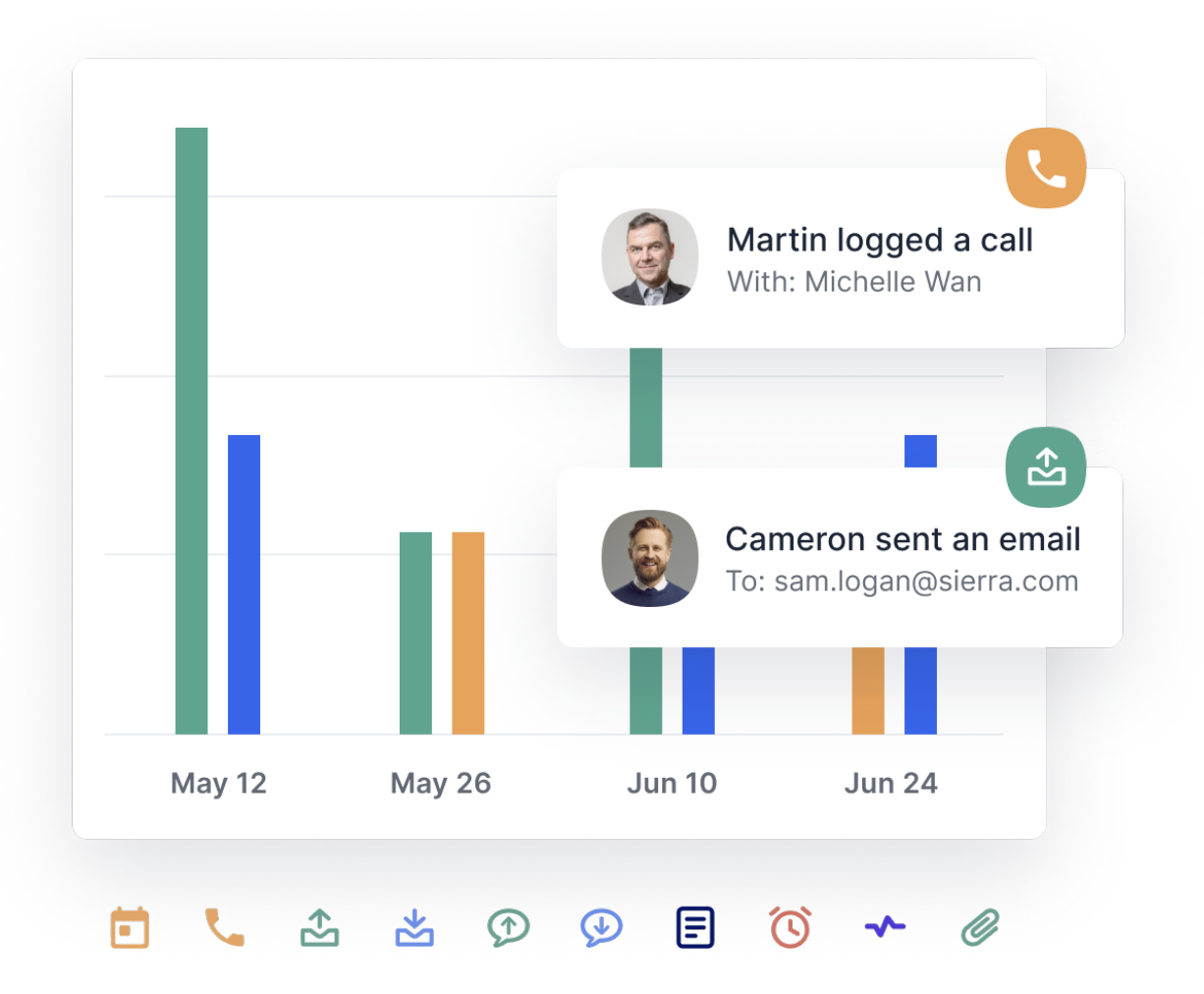
Your firm’s CRM is only as good as the data you record init. Automating data entry guarantees your contact data is current and clear, so your team can focus on driving deals.
With this manual work now automated, your BD team can also build and execute on repeatable processes.Comprehensive activity records consolidate all of your communications with clients, and you can maintain timely, efficient follow-ups on your most valuable deals. Easily surface when an RFP was sent, and set a reminder to check its status in a few days directly in your CRM.
Manually entering and maintaining data in spreadsheets or other, bulkier CRMs creates systems that are inefficient and can go unused. Our research estimates that an automating data entry saves up to 188 hours per person per year. Automation is cheaper, more widely adopted, and more efficient—the quintessential solution for modern consulting firms.
Collaboration
Sharing visibility into relationships and projects across your organization means your team is always aligned and on top of communication with key clients. By combining a collaborative workspace with relationship intelligence and automation, your team can stay aligned and work quickly together.
Having a single platform that consolidates your contact management, opportunity tracking, note taking, and data analytics in one place means your team can search for(and, more importantly, find) relevant data fast.
With a CRM built for consulting you can combine relationship intelligence insights with learned industry knowledge, so anyone that joins your team can become an expert by relying on your captured data.
For client connections that have gone cold, you can reactivate that account by emphasizing your expertise and familiarity with their industry straight from your CRM.
Analytics
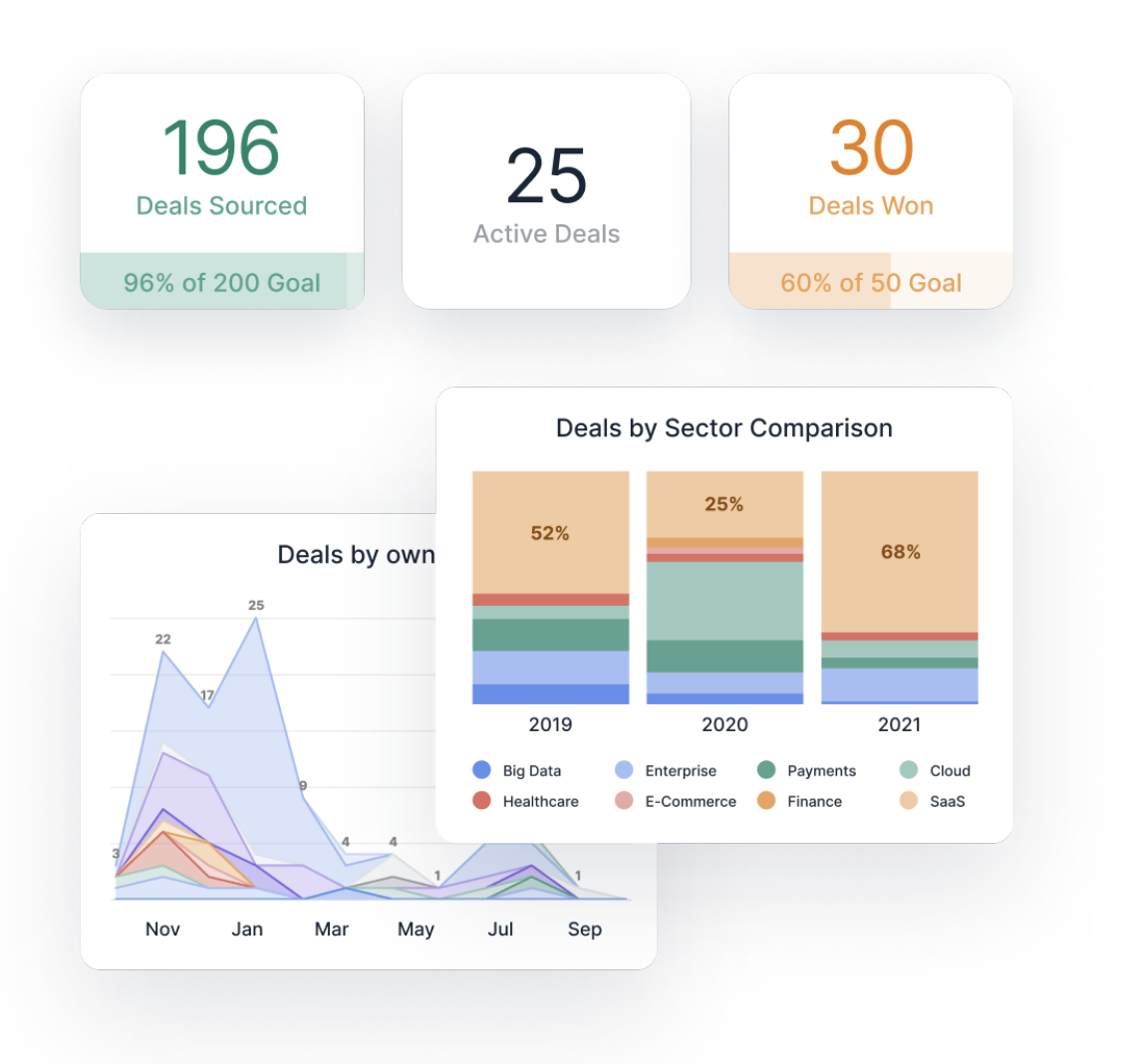
By visualizing your network and complete opportunity pipeline, you can more easily identify and evaluate patterns and find ways to accelerate your business development.
Using your CRM data to analyze your processes means that you can review historical performance data alongside current pipeline activity for opportunity forecasting.
Since reports are pulled directly from the data in your CRM, you can also leverage the data visualizations to tell your firm’s story to prospects. A business development analytics dashboard can support your next pitch meeting and give you a single place to showcase which industries you work with, your current portfolio, and help set expectations for potential clients.
Whether you’re identifying inefficiencies in your deal pipeline, trying to evaluate your team’s performance, or showcasing your successes to a client, built-in analytics make it so your team can make faster data-based decisions.
The power of a CRM for consulting firms
Network and opportunity management seems straight forward: track contact information, follow up with your clients, close deals. The reality is that maintaining your team’s vast network of contacts and opportunities can become unruly without clear alignment around consistent, efficient processes.
When you have clean, automatically logged deal and relationship records available, you can utilize your team’s collective data to make more informed business decisions. These decisions impact both internal processes and external deal and relationship management that all culminate in scaling and improving as a unit, so you can close more high-quality deals faster.