New from Affinity: Agents that follow your firm's playbook, at every stage of the deal
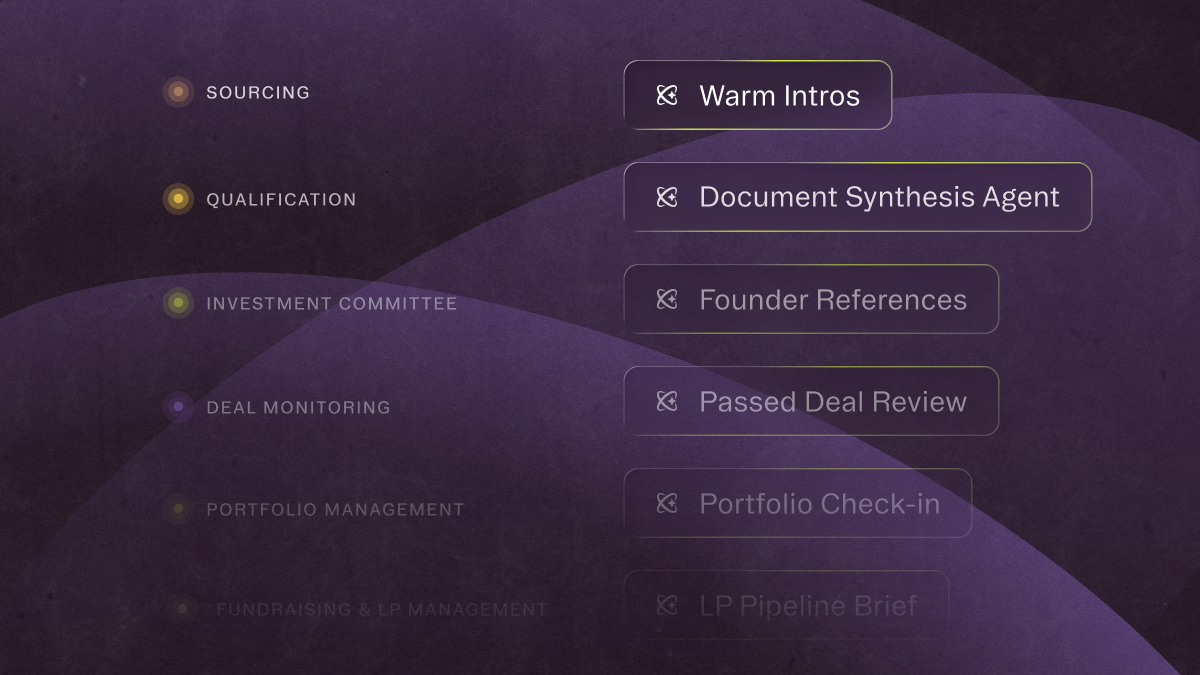

As AI has rapidly evolved from an experiment to an expectation, so has the bar for the quality of its work. We’ve moved from asking for quick answers to expecting finished workflows. Now, agents should be expected to operate like longtime members of a firm, freeing deal teams from tedious and time-intensive work that keeps them from the work only they can do.
But for agents to work like they’ve been at your firm for years, they need better context about how your firm works. Every firm has its own playbook, and your agents should follow yours.
That’s what makes Affinity Ascend different.
Affinity Ascend, the private capital agent platform, now pairs built-in private capital context with your firm-specific context. With firm instructions and cleaner data, Ascend can take on a workflow at every stage of the deal, the way your firm does it.
{{webinar-ascend-whats-new="/rt-components"}}
Generic agents guess
No two firms start from the same place: data lives in different tools, different people build agents, and teams reach them in different ways. A general-purpose agent doesn’t know how a deal moves, what a CIM is, or how a deck differs from a teaser. It doesn’t know your deal stages, what’s worth pursuing, how your IC works, or what firm-specific fields in your CRM mean. At many firms, the call on a deal gets made in a weekly meeting and rarely makes it back into the CRM, so the agent never sees what was decided.
An agent that knows neither private capital nor your firm guesses about what’s what, and the input is generic so the output is too. You find yourself spending more time fixing the work you assigned to your agents in the first place. Those workflows pile up, and they hide the patterns that show what’s working and what isn’t.
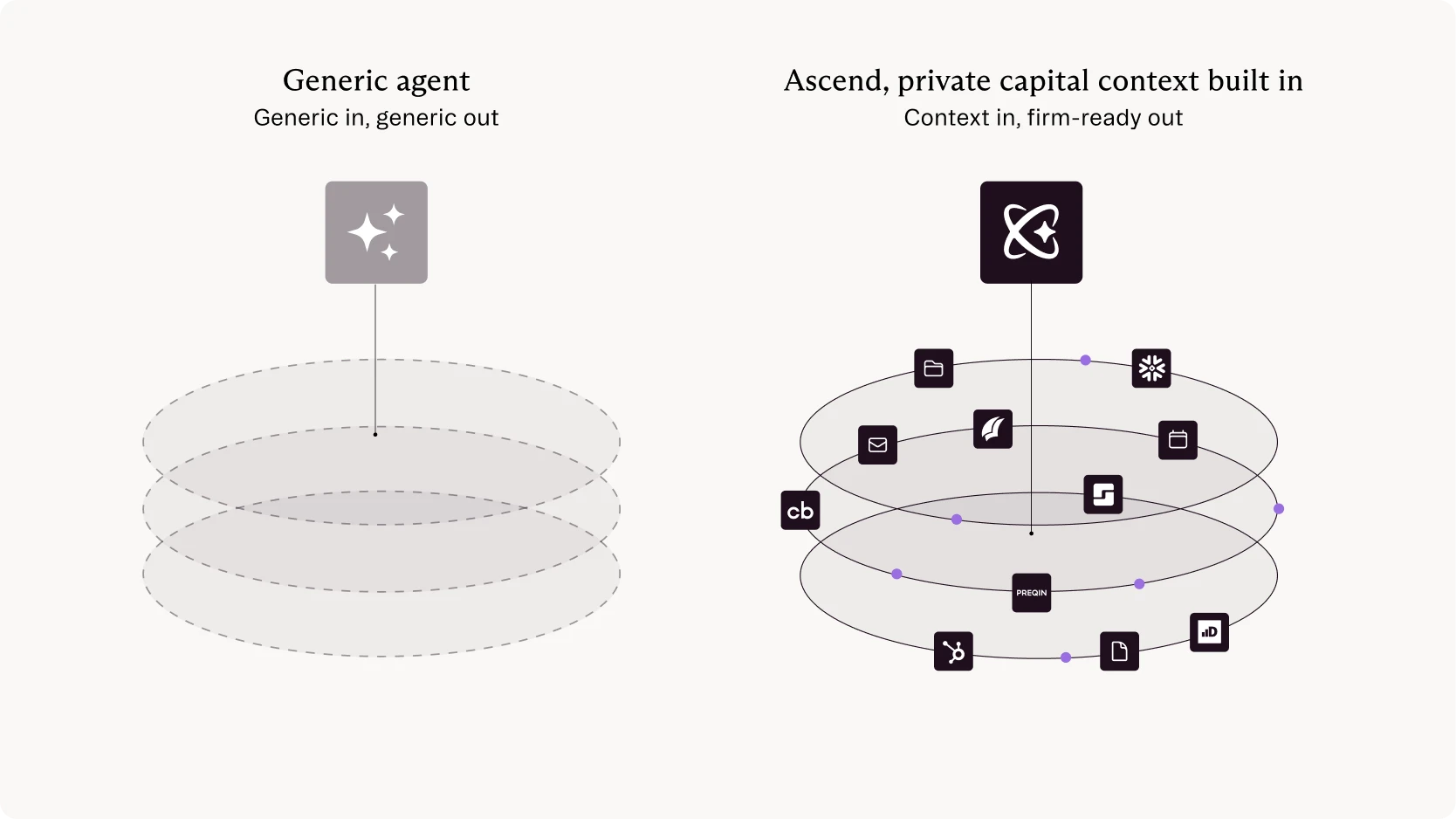
Context, built in
Ascend starts with private capital context already built in. This launch adds the other half: your firm’s specific context.
- Firm instructions. Admins tell Ascend how your firm works: how Meeting Prep briefs should read and what each custom field means. Every agent follows those rules, so the brief a partner gets and the update an associate reviews both reflect your firm’s nuances.
To truly have better context, you need better data. Ascend’s data quality agents turn notes into CRM updates and flag what’s empty, duplicate, or invalid, and nothing changes until you approve, so firms stay in control.
- Data updates from any note. The Data Update Agent used to suggest updates to your CRM from Affinity’s meeting notes. Now it reads any note in Affinity, whether you typed it, pasted it, or sent it in from another tool, like Granola or Fireflies. Write or upload the note once, and Ascend suggests CRM updates. You edit or accept each one, and nothing changes until you say so.
- Fields audited, instantly. CRM Audit reports what’s empty, duplicate, or invalid so the context your agents read from is clean.
A job at every stage
Ascend’s MCP skills and agents apply that context at every stage of the deal so you can delegate the busywork: the reading, retyping, and chasing that keep your team from doing the work only they can do.
That leaves your people to spend their time on the judgment calls that close deals.
{{ascend-stage-table="/rt-components"}}
Wherever your team works
Your team doesn’t live in one tool, and Ascend doesn’t either. New features now extend into more tools your teams already use so you can delegate tasks and analyze relevant insights without interrupting your flow.
- Ascend in Chat. After a call, point Chat to the note and ask for field updates. Data Update suggests them, and nothing changes without your approval.
- Seven new Ascend MCP skills. Ready-to-Raise, Portfolio Check-in, Founder References, LP Pipeline Brief, Passed Deal Review, CRM Audit, and Company Signals run on demand inside Claude, ChatGPT, and Copilot. See all Ascend skills.
- OAuth. Connect AI tools to Affinity MCP with a login, and no API keys to share.
- Microsoft 365 in Affinity MCP. Microsoft Copilot connects to Affinity MCP, so M365 teams work where they already are.
Wherever you are on your AI journey
Every firm is in a different place with AI. Some keep their data in email and notes, some in a warehouse. Some build their own agents, some want agents built and ready-to-use. Affinity works with all of them.
{{ascend-role-table="/rt-components"}}
Since launching Ascend in July, Affinity has overhauled the way firms track companies and opportunities with a new List experience, expanded the Meeting Prep Agent to run on demand, and introduced MCP updates like file upload and download, saved views, and tools to edit, merge, and delete records.
On the horizon: bespoke agents built with firms and scaled into Ascend, intro-likelihood scores for relationship intelligence, customer-built agents that run on Affinity data and context, and headless access, so firm-built agents can use that data without a UI. Hear more about Affinity's direction.
Every firm has its own playbook, and Ascend will continue to keep up with yours.
Related Articles


Put your firm’s network to work